Sunday, 25 May 2014

Watercolour Brushes Pt 3 - Mops

Following up the previous brush posts, one on synthetics the other sables, comes the third instalment -  Mops. Although I have a number they are not my brush of choice. I've used them only sparingly so once again I have enlisted my good friend John Softly to do the honours. 

MOPS by John Softly

If you know your history you will be aware that Edward Wesson was the first artist to use - and popularise - a French Polishers mop for watercolour. I have no information as to when it was that Ted first started using the French Polishers mop but he purchased them initially from France. In an article in the May 1980 edition of Leisure Painter he wrote "Personally I have always used squirrel haired "polishers mops", and in the smaller sizes, a selection of Daylons (nylon) and oxhair". We can therefore  assume that he was using them prior to his stint in the army in WW2. According to Herrings of Dorchester, artists themselves, they first began getting requests for these brushes from Wesson some time after the Wars end and, after great difficulty,  found them in France. Later they got to know him personally as he held many workshops in Dorset, not far from the Herrings shop in Dorchester PW. 


French Polishers Mops  (Isabey)

I  purchased four French Polishers mops in 1973, for French Polishing, from an artists supply retailer but none came to a point and were, what we call today a wash brush. As far as I can recall none came to a point. Those Ted bought did come to a point and they were his main brush throughout his career.

Today there is more written, and questions asked on forums, about mops than any other brush type. Traditionally made of squirrel hair with a quill ferule, bound with wire, but nowadays more are metal ferruled and synthetic versions are coming onto the market as popularity grows.

Not only are there mops in rounds but we have the Petit Gris, cats tongue, or filberts which, thanks to artists like Gerald Green and John Hoar, are increasing in popularity. Flat squirrel hair, one stroke brushes, are also available but it is debatable whether these come under the `mop' banner.

Possibly the major drawback with mops is sizing as there is no standard between manufacturers (this also applies to rounds in both synthetic and sable. PW. John says in response to this as follows: "Your comment is certainly correct but in round sables and synthetics, a Number 10 say can differ in size by a few mm in hair length and diameter but usually smaller to make it an 9 or 8. With mops sizing means little. Alvaro's go from 00 to 10. Harmony from 1 to 10, Jacksons from 6 to 22, Isabey from 3/0 to 10, W & N from 000 to 12 and Da Vinci from 0 to 6. Unless you know exactly what you are getting it's best to ask the retailer actual size or buy from Jacksons - they list ferrule sizes in their catalogue!"). The rounds are the problem as Petit Gris and flats are usually sized in fractions so when you order - for example - a three quarter inch brush you know exactly what you will get. If you order a No 8 round mop you will have no idea what the size will actually be. Some online retailers list hair lengths and diameters, where the ferrule meets the hair, which takes the gamble out of purchases.


Alvaro Castagnet

Prices vary across the range  with the Isabey - made of Kazan squirrel hair supposedly the best - and the Neef Alvaro Castagnet series at the upper price level with others somewhat cheaper. As usual one gets what one pays for and the hair on some of the cheaper brushes would appear to have started life on the tail of a feline (see what is said on this issue of `authentic' hair in the article on sables. Why should mops be any different? PW). One of the better budget sets is the Harmony brand from  Jerrys Artarama, a large American online retailer. You don't expect Kazan squirrel hair from Siberia at this price but I found them to be good, a no frills mop, albeit the hair a little coarser than most.


Harmony


Cats Tongue


It is purely conjecture on my part but I believe the Isabey genuine mops as used by Wesson were, and are, considered the Rolls Royce of mops. While I am not swayed by artists endorsements, Escoda have most high profile artists tied up anyway, I have bought mops with an artists name on the handle. The full set of Neef brushes marketed under Alvaro Castagnets name, and the single, metal ferruled, Escoda mop that Steve Hall sells. The Neefs have a longer handle and hair than most and I purchased them because other Neefs in my collection have performed faultlessly for 20 years.

Neef also do a synthetic mop which has had good reviews but I went with the Neptune brand. They only offer 3 quill mops, 4, 6 and 8, but their synthetic hair is very close to squirrel and by far the most popular synthetic quill mop brush on the market. I've not come across either the Harmony or Neptune brands on sale in the UK. PW

I bought the Steve Hall brush on impulse when buying his book, and whilst I find it a nice, long-haired, brush, softer than most, it is inclined to be uncontrollable when fully loaded. Rosemary & Co make some generic brushes for the British online retailer Jacksons, but I am unaware if mops are amongst them. Jacksons mops however are an excellent product and like all Jacksons own label brushes, built to a quality. rather than price, which is why I suspect Rosemary & Co are involved.


Jacksons Mops


Steve Hall, Princeton Neptune's and Rekab No8.

Rosemary makes  a series 1 Kolinsky quill brush and Jacksons a  series 777 synthetic quill, see the article on synthetic brushes. Although Rosemary calls her Kolinsky quill a mop there is nothing mopish about her high end series 1. They may bear a resemblance to a mop but are round Kolinsky sables and priced and perform accordingly (here I disagree slightly from what John writes based on my own experience with one of these mops, although mine was bought under the old ABS label. PW).

Traditionally polishers mops have quill ferules tied on with wire, the quill coming from the feathers of ducks, geese or swans, depending on the size of the brush. These days manufacturers use firm plastic sheeting in lieu of natural feather quills, but even if plastic it's still called a quill.

There was a time when all round brushes had quill ferrules rather than metal. Sizes took the name from the bird which the feather came from - the smallest a lark, which was the equivalent to a number 2 or 3 modern brush through thrush, crow, duck, goose ans swan - the Americans even had eagle in the mix! The hair was glued into the small end of the quill and the handle, referred to as the "stick", in the larger end but no glue - just a friction fit.

Due to the amount of water mops hold it is important they are dried with the hair pointing down in order that moisture doesn't creep into the ferrule, expanding the wood thus causing hair to be shed. Perhaps I would have more hair than I have today had I been suspended upside down after every shower.

Almost every high profile artist has at least one mop in their arsenal and I'm sure Ted Wesson would be surprised to see just how his mop, which was considered something of an oddity in the 1950s and 60s, has become a standard watercolour brush.

I am aware I have too many mops but, there again, like Peter, when It comes to art materials I have too much of everything, but if I hadn't got them I couldn't review them.


Peter Wards Mops

The top three brushes are Isabey, the large 4th one is a Rosemary squirrel (ABS), the 5th the Da Vinci Artissimo 44 size 2, while the last one is the Kolinsky sable mop series 1 ABS (Now Rosemary) size 4. The Da Vinci 44 size 2 approximates to a size 14 round, although a different shape so you can judge roughly what the other brushes equate to.. Look at the splayed out Kolinsky series 1! Even when loaded with water it doesn't point terribly well and is only useful as a wash brush (in my experience) PW.

My experience with mops is very limited. Currently the only one I use is the Da Vinci Artissimo 44 size 2. Initially I liked this brush very much but have gone off it a little, mainly because the hair became detached from the ferrule, although it was easy to put back in. I am afraid I am not a fan of the Rosemary series 1. Actually it was purchased under the old ABS label but I believe the brushes are the same.

That's it then folks. Thanks John for taking the trouble to produce this and give us the benefit of your experience. 

Friday, 23 May 2014

Stormy Day

This was the penultimate session before the official programme ends. I won't be able to attend next week  so this was my final one. During the summer the hall remains available and members do their own thing. If conditions are suitable several of us may paint en plein air, as the hall is in the centre of the old Saltford village and very close to the river, so subjects are plentiful. Actually attendances last year were slightly higher than during the official programme! Unfortunately I can't recall all of the artists names. I apologize for this as I know it is remiss of me but it is difficult at the end of the session to note all of them and then tie them to a particular painting. I do my best! 


???


Yvonne Harry


Jo McKenna


Jan Weeks


Peter Ward


Pauline Vowles


???

???


Tuesday, 20 May 2014

Water Gatherer

This is from a black and white - more sepia - photograph from the wonderful Facebook resource for old photos of American Indians `Moses on the Mesa'.


18" x 12" Fabriano Artistico, actually on the reverse side of a `failed' painting.

I was very taken by the original photo, although I realised it would be difficult to interpret. I'm not entirely happy with the above but can't quite put my finger on what is not  right. The original is in a sepia shade but as this is mountainous country - and she is getting water from a rock pool - it would be very hot and dry so I used `hot' colours like Quinacridone Gold (DS PO49) and some Translucent Orange (Schminke PO71) to try and convey the feeling of heat. Possibly I've overdone this. Otherwise mostly Raw Umber, Raw Sienna and diluted Cerulean for the Sky with diluted Raw Sienna for the far distance.

I made an initial drawing, not over detailed, and then painted starting with the figure. I then worked outwards away from the figure. The sky and background were painted last. I also tried to convey the feeling of distance. I'm tempted to have another try.

Usual Isabey Kolinsky sables, 4,6 and 8 with the da Vinci Artissimo mop for the sky..

Saturday, 17 May 2014

Latest Paintings

These are some of my more recent efforts. Since moving painting has become more difficult in that I have had other things interfering, and so I've not been painting so often.


12" x 9" Fontenay not 140lb

The Secretary Bird for the `Paint Colorful Birds for Fun' community on Facebook. I decided to do a head shot rather than the whole bird so I took the easy route!


16" x 12 Waterford not 140lb

Beyonce - from a black and white cover photo in the Observer Weekend magazine. On the original photo both the hair and skin looked very bland so I jazzed this up a bit.


Tropical Beach Scene -18 x 12" Fabriano Artistico 140lb not.

This was done for an AVA session titled `On the Beach'.


Friday, 25 April 2014

The Ceylon Magpie

I'm afraid you'll have to put up with another bird.! I missed the AVA session yesterday as I'm still suffering from a cold and accompanying cough, although this seems at last to be moderating. This is the latest subject for the Facebook community `Paint Colorful Birds For Fun'. 


The Ceylon Magpie - Approx. 16" x 12" Waterford 140lb (300gsm) rough

I initially made a pencil drawing, Pentel mechanical pencil 07 2B.  Painted this the following day about 40 minutes. Colours were Translucent Brown (Schminke PBr41), Quinacridone Coral (DS PR209), Blues Phalo Blue, Ultramarine and Cerulean. Possibly some Turquoise (Lukas PB16) and a little Ivory Black (Maimeri). The greens are Viridian (PG17), Phalo Green (PG7), Sap Green and Green-Gold (Rowney PY129) also some Raw Umber on the branches.

Only three brushes. The Isabey retractables sizes 4 & 6 and the Isabey Kolinsky sable Size 6.


Monday, 21 April 2014

Zebra Finches

This was last weeks subject on the `Paint Colorful Birds for Fun' community on Facebook. I've only seen these little birds in captivity but they seem to live in groups so after the initial bird on the branch added impressions of three others.


16" x 12" Paper ?. 140lb not (back of the paper)

These are basically quite quick sketches so I'm fairly happy with it as it conveys what I wanted with a huddle of the birds. The great thing about these bird sketches is that they encourage bold use of colour. Not a subject for the limited palette enthusiasts. 

Only three brushes, all Isabey, retractables 4 & 6 plus size 6 Kolinsky. 

Tuesday, 1 April 2014

New Watercolours from Winsor & Newton


Winsor & Newton,  perhaps prompted by the rise of Daniel Smith, have introduced what they are calling a limited edition `Desert ' collection of 6 new colours, all single pigments with two I've not heard of previously. In addition W & N have recently changed their tube design and are now calling the range `professional watercolours'. Sounds like the marketing department has been having a field day.


They are only available in 5ml tubes and are listed in series three which makes them expensive. However Jacksons are currently charging £4.61p - still very expensive. The colours are as follows:

Phthalo sapphire. PB15:6 - This is one of the phalo blue pigments and this one is currently on offer from at least three other makers, Daniel Smith, Lukas and Schminke. All three offer this pigment, `Phthalo Blue', `Helio Blue Reddish' in larger tubes and at lower prices, apart from Daniel Smith who are expensive, at least in the UK.

Indian Red Deep. PBr25. Previously this pigment has only been available from Daniel Smith as `Permanent Brown'. Handprint say `not an essential pigment'. Ian Sidaway gives it a good review in the current magazine `The Artist' but calls them all relatively expensive `...and might put them low down on the shopping list of many impoverished artists'. The pigment database says PBr25 is `deep red violet brown'. Added 08/04/14; I have just discovered that Holbein have added a number of colours to their watercolour line. Amongst them is `Imidazolone Brown' which is PBr25. There is also Imidazolone lemon, yellow deep, and yellow. I note another new colour `Grey on Grey'. Regrettably since Handprint decided not to update pigment information we are beginning to fall behind.

Transparent Orange. PO107. ` A zingy red-orange'. I've not heard of this pigment but it sounds rather like the Schminke `Translucent Orange' PO71 and the similar Lukas `Permanent Orange' PO71. This Schminke colour is one of my favourites and also the well-known artist Jean Haines. The pigment database www.artiscreation.com/  says PO107  is `Bright reddish orange'. Added 08/04/14: The pigment database calls PO71 a `dull mid-orange'. To my eyes (and others) it is anything but dull and is certainly reddish.

Dark Brown. PY164. Another pigment I've not heard  of previously but note the `PY' which signifies yellow. Ian Sidaway says `it is used in various named browns' Which ones? I couldn't find this one in the pigment database.

Yellow Titanate. PBr24. Currently this pigment is used in the W & N Naples Yellow Deep. What is different? I've no idea and again Sidaway claims PBr24 is used in a range of different named yellows.

Gold Brown. PBk12. Again claimed to be used in a range of named browns but not in either the Schminke and Lukas ranges or previously Winsor & Newton.. The pigment database calls this `dark red to brownish yellow black'. An interesting comment is that this colour is `not dissimilar but is slightly duller than Quinacridone Gold'.

Are these colours worth buying or are they just another attempt to extract more money from  long suffering watercolour artists? You will have to make your own mind up. Winsor & Newton paints are still excellent quality and can be bought at discounted prices from the mail order suppliers. The range of colours available is daunting and caters for every need. Do you really need any of the above? I suggest that the most interesting paints (pigments) are the Transparent Orange and Gold Brown for reasons I've already stated.

Friday, 28 March 2014

Wreck 0r Wrack & Ruin

This was the subject at Thursdays AVA session. Only ten members were present due to various reasons, including dislike of the subject. Some of the weekly subjects don't appeal to me but I`ve never stayed away because of this and usually finish up having enjoyed the challenge.


Robert


Jan


Gerald


???


John


Angela


Peter


Lots of variation as you can see. In my case I'm doing another piece on the Airacobra as there is an interesting and historical story attached to it. It won't appeal to everybody but connects with another of my interests.

Tuesday, 25 March 2014

More Paintings I like

Just to lighten the mood while I await the next  onslaught from `anonymous' (just joking) here is another selection of paintings that caught my attention. I'm sure some may not be to everyones taste but there is sufficient variety, apart from super realistic as I prefer looser more impressionistic paintings. 


from the delightful Stephie Butler


Vickie Nelson  - an excellent artist


Morten E Solberg Snr - another terrific American artist


John Yardley - still one of the best British watercolour artists.


Viktoria Prischedko - amazing talent


The prolific Milind Mulick


Burhan Ozer from Turkey


Yuko Nagayama from Japan - amongst other things she uses ten different varieties of salt!


Henry Arafin


Alvaro Castagnet - the well-known workshop artist


Winslow Homer - legendary American 


Finally Robert Wade - the doyen of Australian watercolour. This scene above is in Bristol where one of Roberts sons was an intern at the main hospital.

I know most of these artists if not all. Once again the different interpretations and use of colour are worth studying. 


Friday, 21 March 2014

Birds & Butterflies (2)


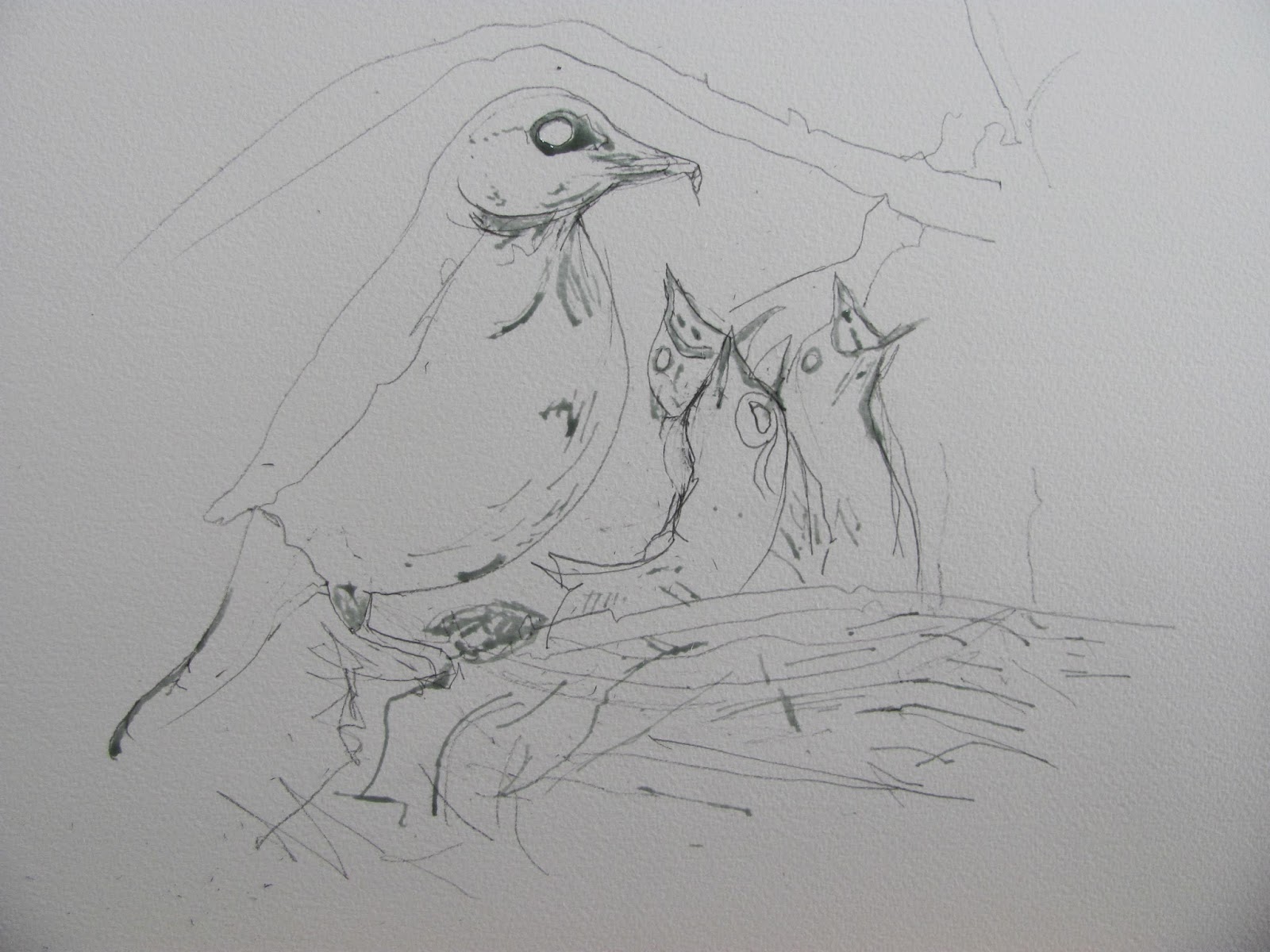
The subject for `Paint Colorful Birds' this week was the Song Thrush, one of my favourite birds. Unfortunately there has been a large decline in numbers in the UK in recent years. In my previous home at Saltford in the early years we had Song Thrushes in the garden regularly, and even nests on occasion. In the last ten years or so it was rare to see one although I occasionally saw thrushes in the fields or community wood close to my home. There are different theories as to why this is but one of mine is that the rise in blackbird numbers is one possible cause. Blackbirds are very aggressive and bully thrushes. Both birds have similar territories and blackbirds won't tolerate thrushes, driving them away and putting them under severe stress. 

The above drawing was based on a photograph showing a thrushes nest with young, on a branch of what looked like some sort of fir. I decided to concentrate the drawing on the birds. Small amounts of Pebeo Drawing gum was put on with a ruling pen, mainly about the heads. This was done the day prior to the AVA session. I find by doing this one is able to approach the painting in a more considered way. Many of the others are doing something similar as we only have two hours in total and it is surprising how quickly this passes. 


Song Thrush with young. 16" x 12" Waterford High White 140lb (300gsm) not

I am fairly happy with the result although I realise the back of the adult is too dark. This is again my fault for following the photograph too closely, although the surroundings have been depicted very generally. I've since looked at Gerard Hendriks painting of a Song Thrush and admire his interpretation.


Butterfly - initial drawing with masking fluid applied in small amounts for highlights.


Butterfly - 15" x 11" paper (?)

This was a loose colour study in less than 40 minutes.. The reds are Quinacridone Coral (Daniel Smith PR209) and Translucent Orange (Schminke PO71). The greens are Sap Green (Graham), Green-Gold (Rowney PY129), Phalo Green (Maimeri PG7) and Green Apatite (Daniel Smith). Also Ivory Black (Maimeri). The purple is Quionacridone Purple (Daniel Smith (PR255). 

My brushes a mixture of Escoda, Isabey and Rosemary retractable or travel brushes.