In the past I've collaborated with my friend John, notably on brushes and easels, taking advantage of John's experience and expertise on these subjects. On this occasion his knowledge of the iconic English artist Edward Wesson is unsurpassed so the obvious thing was to get John to write the article.

Edward Wesson died in September 1983 and yet his popularity is greater now than it was during the years prior to his death. Known primarily as a watercolourist but like many others working in the medium also painted in oils.
He was prolific and said that one painting in four was a keeper - the rejects were usually given away to students in his courses and there are art dealers scouring the country in search of these rejects as they are worth their weight in gold - literally.


Born in the closing days of the Edwardian era (April 1910) in the London suburb of Blackheath, upon leaving school he found a job in the textile industry.
It was after his marriage to Caroline, always referred to as “Dickie”, in 1937, that Ted became interested in painting and studied the methods of E W Haslehurst and Adrian Hill.
He served in the Middle East, Sicily and Italy during World War Two and an encounter with Ascanio Tealdi, a Tuscan oil painter, was responsible for Ted learning to paint in oil. Within three years of being demobbed his oil paintings were being accepted by the Royal Academy.
The Academy never accepted any of Ted’s watercolours but the Royal Institute of Painters in Watercolours did as did the Royal Society of Marine Artists.

Ted’s work ethic was amazing and it was recorded that, at one time, he did five watercolours in the forenoon and cut the grass in the afternoon. He painted in the English tradition and had little time for gimmicks. His comment was “Those who can do - those who can’t teach - and those who do neither become critics’.
The most publicised thing about Ted’s technique was his use of a polishers mop. He found the first one in France and later the Herring brothers of the Dorchester art supplier obtained them for him. He used sizes 6, 12 and 15 but I think they were rounds although Ted’s brushes given to Steve Hall by Ted’s daughter, Elizabeth, had a couple of smaller sized squirrels and as we know the sizing of these brushes has never been standardised. In addition I have had a good look at Steve Halls video 'Watercolour Secrets' on the big screen. The brush roll given him by Elizabeth Wesson as being the brushes left in Teds studio, at the time of his death, are dissected by Steve and the numbers I gave 6, 12 and 15, certainly refer to the mops. There doesn't appear to be a round larger than 8 and the mystery brushes are three flats. Ted never mentioned flats in any of his articles, and although they appear pristine they must have been there for a reason. I've always assumed the 'mops' are what are currently known as Isabeys? PGW

His gear consisted of a Winsor and Newton Perfect Easel, where he complained that the wing nuts used to unscrew and land in the snow or sand, initially a De Wint palette, followed by a Binning Monro and finally a Holbein 1000. They were filled with the following W&N artist tube colours :-
Raw Sienna, Winsor (or Cadmium) Yellow, Burnt Umber, Light Red, Burnt Sienna, Winsor Blue, Ultramarine Blue and Cobalt Blue.His palette for his pen and ink wash was:- Payne’s Grey, Burnt Umber, Burnt Sienna and Raw Sienna. The other colour he used extensively was “filth” which was the amalgamation of all the used colours on his dirty palette.
The Bockingford paper he used was made especially for him by Reme Green of Barcham Green the surface being rough and the weight 140 pounds and heavier. According to Ranson he approached Green and asked him to make a heavier weight. The result was the 200lb Bockingford which is popular to this day. John says that this was the rough surface and was the only one made at the time. Now 200lb Bockingford in both rough and not surfaces is readily available and they even make a 250lb weight. PGW

His method was to place a few pencil dots on the paper for key points and then straight in with the washes. No sketch books or detailed drawings?.
Ted Wesson traversed the country in his Renault doing courses and demonstrations and was always happy to pass on his knowledge of the medium. He was also an excellent organist and would play church organs in many of the places where he conducted courses.

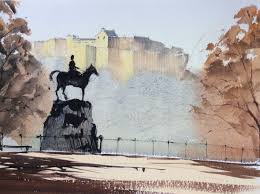
A source of income was the London store Liberty’s and Elizabeth Wesson recalls that they would ring up for “ Four more paintings of Tower Bridge or some other location” which Ted would have to do immediately. There were times when Ted would take Elizabeth to London with him and she had to be on her best behaviour as “We would be seeing the Lady from Liberty’s” .
Ted wrote his autobiography “My Corner of the Field “ in 1982, a superb book of which he was justly proud. His other foray into journalism were articles for “The Leisure Painter” ( 13 issues) and “The Artist” (18 issues). A couple of these were on oils but they were mainly about watercolour. There have been 5 biographies written on Edward Wesson, two of them co authored by Steve Hall, who paints in the Wesson style and has done more than anyone else to keep the memory of Edward Wesson alive.
Had there been APV and Townhouse instructional videos in Ted’s day he would have surely been keen to use the medium as he was one of the best teachers of watercolour the country has produced


Wesson was amongst a group of artists commissioned by British Rail to paint posters of specific rail destinations for promotional use and also to be displayed in railway compartments - under the luggage rack. Later the Post Office Savings Bank asked him to do promotional paintings of small obscure Post Offices in the British Isles a task which necessitated travelling to small villages in far flung corners of the country. The Post Office paintings were true watercolours whereas the Railway posters, by necessity, were done in gouache.
In 1958 “The Wapping Group” invited Ted to join their number and during the summer months he would travel from Guildford to London every week to paint scenes on the River Thames with the group. Due to his workload of courses, lectures and exhibitions his time with the prestigious group only lasted a year but resulted in many marine works.


On a personal note. Edward Wesson’s paintings have been a source of enjoyment to me over the years and obtaining all the Leisure Painter and Artist articles as well as the six books was a labour of love. Anyone wanting to delve further into Ted Wessons art could do no worse than obtain a copy of 'The Art of Edward Wesson' by Ron Ranson, himself a watercolourist of note, who has written biographies of several artists, all of which are excellent. My thanks to John for producing this superb account of Edward Wesson, without doubt an iconic English artist and - I believe- a real 'character' in the English sense.


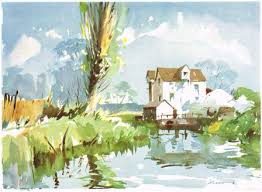
This is the East Anglian village where John, resident in Australia, was born.
There have been a few errors concerning the paintings, entirely my fault and not John's. They've now been corrected apart from one painting that is in gouache but I'll leave that in. John was responsible for the text and myself the illustrations. As you know he's in Australia and I'm in England (and we're both getting on, especially me, a bit.) so apologies again.


