Sunday, 19 July 2015

Nora

This is my latest Indian portrait painted at the AVA session last Thursday. 


Nowad luk (Nora) Ootenna Inuit Amerindian 1915 16" x 12" Centenaire 140lb (300gsm) not

I downloaded the original photograph from Pinterest OR it may have come from the Facebook community `Moses on the Mesa', a treasure trove of old Indian photographs. I don't really do it justice as in the photo her beautifully groomed hair tumbles down to her waist. Frankly I didn't feel able to portray this in a way that does it justice. Artistic licence?

I made a pencil drawing, not over detailed then painted, starting with the eyes, nose and mouth then gradually the rest of her face. When dry I put stronger colour in for the shaded areas. Colours used were limited to Cadmium Red Light, Raw Sienna, Ultramarine Blue and/or Cerulean Blue. The hair is a mixture of Ultramarine Blue, Burnt Umber with some Raw Umber. With more thought I might well have used other colours as I did in the Amy Winehouse painting. The original guide photo, as usual with these Indian paintings, is in black and white tending towards sepia.

Brushes used were Isabey, Escoda and Rosemary travelling brushes from 6 to 10.

In general I think it reasonable. I masked out some areas around the eyes and left them the white of the paper. I've pondered whether that was correct - too much white - but as I'm uncertain decided to leave them as they are rather than touch them up with some pale reddish washes.

Tuesday, 14 July 2015

Watercolour Paintings (6)

Another selection of watercolour paintings with a mix of artists, some old (and well-known) others new. Hope you like them. A variety of styles .


Bev Jozwiak. A slightly unusual study for her but I love it.


Cao-Bei-an - The well-known Chinese artist.


Michelle Clamp - This lady is now heavily involved in the `Facebook community `Paint Colorful Birds for Fun' .


Christian Couteau - of the very distinctive style.


Charles Reid


David Taylor - one of the leading Australians.


Dusan Djukaric - look at the placement of the figure!


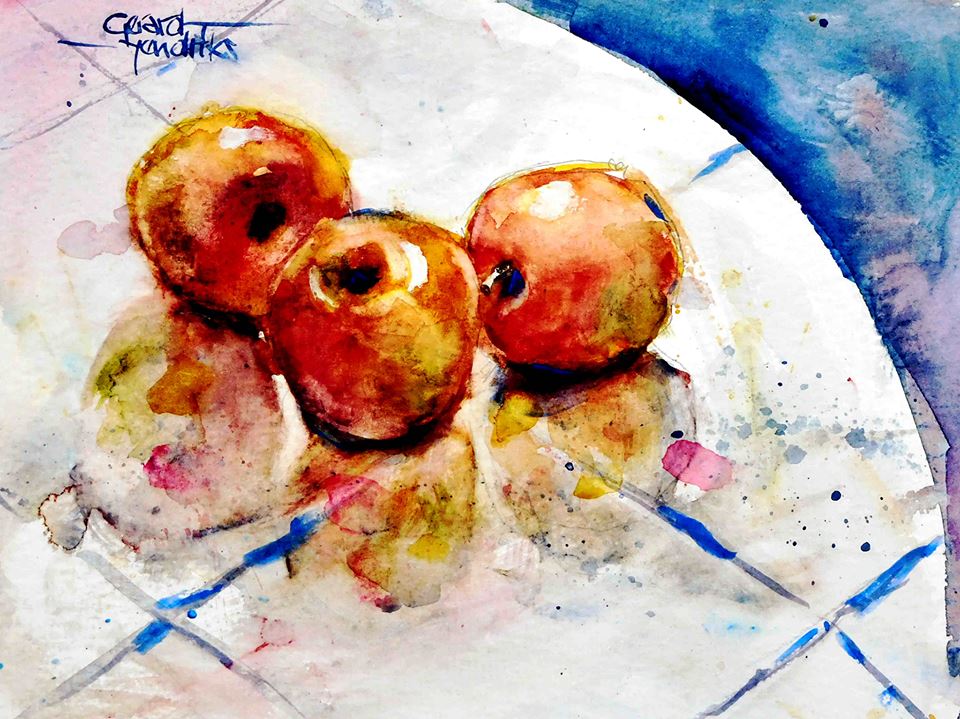
Gerard Hendriks sketches


Gerda Mertens


John Singer Sargent - enough said


John Yardley - still going strong at approaching 80, although this is one of his older paintings.


Jonathan Kwegyir Aggrey - a brilliant young African artist


Kate Osborne


Kuo Hsin-i

Some of these artists like Singer Sargent and John Yardley need no introduction, neither does Gerard Hendriks, Bev Jozwiak, Cao-Bei-an, Gerda Mertens nor David Taylor. The remainder I know less about but some `googling' would undoubtedly bring more information and they are all on Facebook in some form or other. 

UPDATED INDEX TO THE BLOG - JUNE 2014.

Saturday, 11 July 2015

Espon Unzo Owa

Despite my `anonymous' critic I continue to paint Amerindian portraits. Last week I was in Bath and called in  at `Good Buy Books' a shop that sells remainders - in other words new books at greatly reduced prices. I have bought many books at the shop but this was an unusual one. I spotted a book called `Edward S Curtis' by someone called  Hans Christian Adam. This was published by Taschen who, I am told by a keen photographer friend, specialize in high quality photographic books. It was £8.99p and although it did not show the original price I believe this was a fraction of it.

Edward Curtis created the largest known body of photographs of the North American Indian.devoting 30 years of his life to the subject. He has actually gained more fame in the years since his death. His most famous work is entitled `The North American Indian' which is a 20 volume series beautifully produced in a limited edition with an original price of $1000. I can't imagine what copies cost today.

When I bought the book it was encased in cellophane but when this was removed I wasn't disappointed. It has a superb collection of his photographs, a few of which I already knew but many I'd not seen before. No doubt more paintings will follow.


Espon Unzo Owa - Mohave Tribe 1903 16" x 12" Arches Hot Press

This is one of several paintings I've done on hot press, not all indians, and it certainly creates a different effect to other watercolour surfaces. Unfortunately not being an expert photographer it seems to me my paintings often lose something between photographing the original and transferring it here. Looking at the actual painting I think it better than the image above. Maybe this is just me making an excuse for my deficiencies as an artist. I keep trying.

The main problem in tackling this and other similar subjects is that the guide photos are sepia coloured and tend to be on the dark side with excessive contrast. Colours include a lot of guesswork on my part. I don't strive for a super realistic result but try to capture the subject with an impressionistic approach - the Charles Reid way. Sometimes it works sometimes it doesn't. I did this at the last AVA session and some of my fellow painters remarked I'd captured his likeness.

I used my small Craig Young Sketch box with Cadmium Red Light, Raw Sienna and either Ultramarine Blue or Cerulean, in various proportions, for the skin colours. Brushes were Isabey, Escoda and Rosemary travel brushes from size 4 to 10. The hair was a mixture of Ultramarine Blue and Burnt Umber with a little Raw Umber.


Sunday, 5 July 2015

Latest Paintings

At the AVA session last Thursday I decided to continue with  animal paintings. I picked the subjects from photos I'd saved to the ipad and made the initial drawings the day before the AVA session. I used a 2B lead pencil which I sharpened before proceeding. The procedure again was to make a loose drawing, as accurate as I'm able, with not too much detail. I'm still affected by the accident to my right hand, that dislocated my little finger. My control has been affected and it's hard to be precise - even though I try not to be too fussy and don't want to get over detailed.


 Stage One - Cheetah and cub.


Painted the cub first, the head of mother then started on the greenery


16" x 12" Centenaire 140lb (300gsm) not


Tiger Waiting for Prey - 16" x 12" Waterford 140lb (300gsm) not


A closer look


16" x 12" Tiger Waiting for Prey! Waterford High White 140lb (300gsm) not

You may note that the paintings don't take up all the paper. I am loath to cover every inch with paint and the approach is more towards a vignette. I don't plan to frame them but if I did something like 12" x 8", with a wide mount would probably do. 

I completed the paintings in two hours, the exception being the Tiger where I added some white acrylic paint three days later.

Colours used included Raw Umber, Raw Sienna, Translucent Brown (Schminke), Quinacridone Gold (DS PO49), Quinacridone Rust (Graham PO48), Cerulean Blue, Ivory Black, Sap Green (Graham), Apatite Green (DS) and possibly touches of one or two others. Ultramarine Blue with either Translucent Brown or Burnt Umber for the darks.Does it look as if I've gone mad and used too many colours? I don't think so myself - why not?  

Brushes used were the Isabey Travel brushes Sizes 4 and 6, Escoda travel brushes 8 & 10 and the Rosemary Kolinsky travel brush Size 6. I think that's it.


Wednesday, 1 July 2015

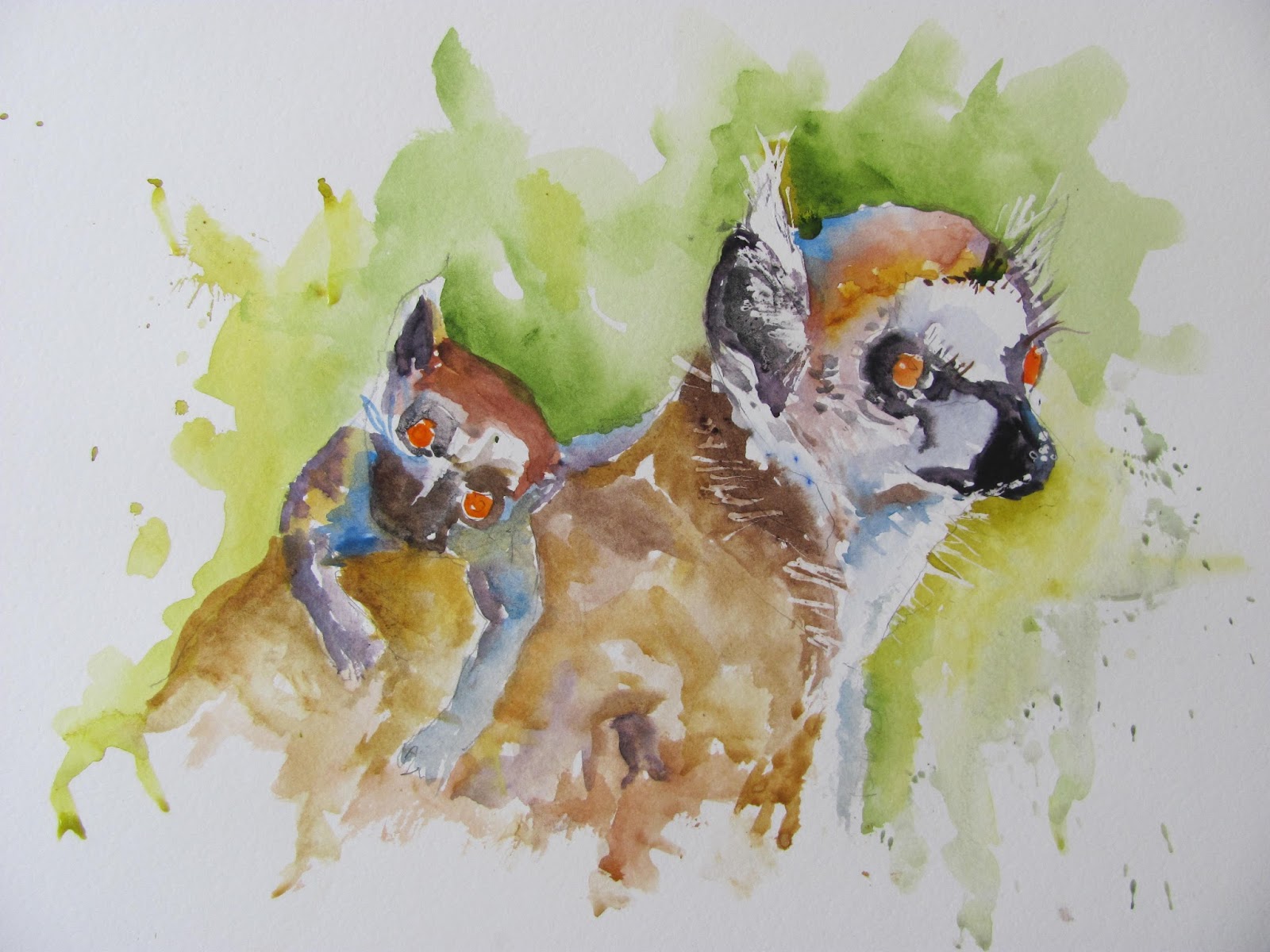
Latest Painting - Lemurs

I like painting animals and birds, and last week at an AVA Summer session I decided to paint some Lemurs, from a guide photo downloaded from the Web. Lemurs are mainly quite small animals native to the large island of Madagascar, in fact they are found nowhere else. According to a recent BBC programme there are 106 species and all are in the endangered category. Because of their appearance, which might be called `cute', they are a favourite of many and the highly popular animated children's film `Madagascar' , which most grandparents have probably seen, featured them heavily, undoubtedly adding to their popularity. The problem in Madagascar, as in many other poor countries, is the low standard of living of the bulk of the population, and in order to improve this deforestation , which reduces the Lemurs habitat, is being practiced on a large scale, in order to increase farming area. This is a very difficult problem because, in general, indigenous people see animals as competing with them for scarce resources and getting them to conserve both the animals and the environment is difficult when survival is their main interest. It would be tragic if they were to disappear.


The guide photo


First a loose drawing, quite lightly drawn


Just the main details


About two thirds of the way through


Mother & Child Lemurs - 16" x 12" Centenaire (Great Art own brand). 140lb (300gsm) not

I think the eyes were the key so I took as much trouble as I'm capable of using the Isabey Kolinsky travel brush Size 6. As I've said before, although listed as a 6, this brush is much slimmer than a normal six. 

Colours included Cerulean Blue, Raw Umber, Ivory Black, Transparent Brown (Schminke) and the eye colour (I think) was Quinacridone Coral with perhaps a slight tweak with another red-orange colour. Greens were Sap Green, Green-Gold and Apatite Green.

Brushes were primarily the Isabey and an Escoda travel brush size 8.


Sunday, 28 June 2015

Watercolour Paintings (5)

Another selection of watercolour paintings, mostly from well-known artists. A variety of different styles with something for everyone (I hope).


Millind Mulick - A very prolific and terrific artist with a huge following on Facebook. Uses a lot of green, considered a difficult colour by some artists.


Alvaro Castagnet - One of the top Worldwide workshop artists - enough said


Bev Jozwiak - this one and the one below are typical Bev. I love her jackdaws. She has a book out but you won't find it on Amazon or in Waterstones unfortunately. You will need to hunt it down probably via her website or Facebook page.


 Bev Jozwiak


Christian Couteau - A very distinctive style and use of colour.


Charles Reid - My guru (along with Gerard).


 David Taylor - One of the top Australian watercolourists


Edo Hannema - again less well-known but still good and this one appealed to me with its simplicity and subtlety, very hard to emulate.


Gerard Hendriks - a change from birds and animals, simple yet effective. Not one of my favourites - I love his birds.


Gerda Mertens - the famed Belgian artist, this one unfinished but very interesting to study how it is developing


 Jem Bowden - I don't know much about this artist, conventional but effective village scene, typically British.


Liu Yi - a Chinese artist now teaching at EPC Catalonia. Look how subtle this is.


N B Gurung - another  high profile artist with a large following on Facebook. 


Nita Engle - the terrific American artist who wrote an interesting book detailing her methods. Not for the fainthearted! I remember Ron Ranson showing her book to his students on a workshop.


Trevor Chamberlain. Considered one of the very best British watercolour artists, although originally painting in oils. 


Vickie Nelson - not so well known as some of the others but excellent nevertheless

Thats it then. I hope these prove interesting. I wish I could paint as well as many (most) of these people. You can almost certainly find the majority of them by just `googling' the name if you particularly like their style.  They are all on Facebook and some at least have their own web sites..


Wednesday, 24 June 2015

COMMENTS

 I have recently had a small number of comments, mostly `anonymous' that I've taken exception to. One in particular has posted two in which he made sneering and snide comments about my attempts at Indian Portraits (and the fact I misspelled Amy Winehouse) - the last  saying I should give up Indian portraits. Well he's entitled to his opinion, it's the way he (I presume it's a he) expressed his views that I objected to, under this `anonymous' title. Anything that is `anonymous' is deleted as a matter of policy by the way.

I paint as a hobby and the actual  painting he objected to isn't a million miles away from the one I used as a guide. I'm not suggesting it is good or even 100% accurate as I have no illusions about my ability as an artist. All these posts emanated from Americans it would appear - not all on the same topic. I'm not anti American having been there many times. It's a wonderful country and the majority I've met have been really nice people, in fact some from Florida we met on a tour invited us to come and stay with them.

During the time I've been doing this blog I've had very little unpleasantness. The blog is just a hobby not life and death - there are far more important things happening as anyone keeping abreast of the news - not least in America - knows. .On one occasion a less than fulsome review of the then new magazine  `The Art of Watercolour' brought an anonymous comment that I was a moron. On another occasion a young lady got hot under the colour about the difference between amateurs and professional but later apologized after I pointed out it was the way she expressed herself not her actual opinions.

To clarify. To those who need reminding don't bother posting such stuff because it will just be deleted, especially, but not only, if it is anonymous, nor will I respond to it.  This sort of confrontational attitude isn't acceptable on a blog of this nature and I won't allow it.

Tuesday, 23 June 2015

Easels Pt Three by John Softly

THE HERRING VERSATILE EASEL

This the last installment of my take on artists easels consists of three of my favourites.The Herring Versatile Easel is a relatively expensive item (currently £109) for those living in the UK but the shipping costs to Australia double the price (the same applies for UK artists with regard to SunEden products from The USA which aren't cheap to start with PGW).


This easel has been in continual production for 55 years and is possibly the sturdiest easel I own. I did send e-mails to Potter in Norwich as I liked the wide support (see my view on the Potter PGW) but received no answer so I went for the Herring. Just as well I suppose as the heavier Potter would have cost more in shipping costs. The Herring weighs in at 1.5kg. I am unable to use the Easel Butler but can utilize the Best Brella. There are a couple of accessories for this easel. A metal shelf, 12" and 18" extension for the aluminium support and metal picture slides.


 Picture slides,12" extension and shelf.

Due to the shelf being somewhat narrow I am forced to use my Craig Young Paint Box as my usual palette, the CY palette box is far too large. As you can see the Paint Box fits perfectly.


The artist Robert Brindley, who uses both a Herring and a CY Palette Box, has bolted a larger shelf onto the small Herring shelf, which holds his palette and mixing palettes, something I intend to do. See it on his Town House DVD.


WINSOR AND NEWTON 116 PERFECT EASEL

I have had more trouble with wooden field easels than any other type. Due to my insistence that the ensemble be solid and not move when erected. I have sold or given away three Mabef wooden field easels. The problem was with the screw at the apex, which when tightened with normal pressure did not hold the legs and support tightly.More force was needed and the obvious happened - I stripped the thread.

Both Trevor Chamberlain and David Curtis use a W & N "Perfect" easel, having done so for the past forty years, so I considered that an excellent reference. The trouble is the last advertisement I saw was in an artists magazine from the late 1960s and I believe production ceased in the 1970s. However everything comes for those who wait and sure enough one appeared on eBay in Dublin. Not only a Perfect easel but one in the original box with papers. I was the only bidder so was I wrong in thinking this the best wooden field easel? My view is that this is the bees knees of easels. 


The apex screw holds the legs and support bar firmly, unnecessary force not being required.


The inlaid W & N Logo

Currently I am using this one more than any other, even though I consider my original Manfrotto photographic tripod the most versatile due to the ball head. I have no link for this easel, but refer you to the writings of Trevor Chamberlain and David Curtis.

 THE CARVER TABLE TOP EASEL

This easel is from Malcolm Carver, a high profile Australian watercolourist. An acrylic A3 board with weighted foot and ball head makes this the best table top easel I have found. It is also the most expensive.


The Carver easel ball head

I have other table easels but the Carver with the ball head is by far the most versatile.


To conclude; there was another high-profile English artist who used a `Perfect' easel and that was Edward Wesson. Between 1961 and 1981 Ted Wesson wrote 18 articles for `The Artist' and 15 for `Leisure Painter'. 

Ted died in 1983 before the advent of art videos and DVD's so his autobiography "My Corner of The Field", the five books written about him, the 33 articles penned by him, a couple of 16mm short films and the thousands of paintings he produced are the only insights into the man and his art. All six books mention his palette and the use of a French Polishers Mop. However in his magazine articles he delves deeper into methods, techniques and philosophy with eight quotes on easels.

My easel is a makeshift one, being an adaptation from the rather useless type often given to children. Not being a carpenter I will not attempt a description of it. Sufficient to say it is light in weight and simple to handle.( The Artist - March 1962)

Our easel should be light in weight and easy to carry. It can be one of the orthodox patterns or the camera tripod type with a swivel top and the appropriate screw fitting, which attaches to the board. There are a good variety of both types available. ((The Artist - January 1964).

The easel should be light in weight and I can think of none better than a metal telescopic tubular type. In a stiff breeze this may need a brick, but don't take one with you! There are usually some kicking around on the site. (The Artist - August 1967)

To my mind an easel is a must and the one I would recommend is the `Perfect'. This stands up to most conditions pretty well and can be used very satisfactorily for both watercolour and oil painting. ( Leisure Painter - June 1975)

Now whether we stand or sit .... one of the most essentials items in our equipment will be an easel and here we need to exercise care in our choice. One called `"The Perfect"* is most reliable, not too heavy but  fairly firm and safe. There is one lighter weight which has so many wing nuts to negotiate that, if not careful collapses as soon as we look at it. There are other more elaborate ones that look more like dentists chairs but I doubt whether they are any more efficient. As with so many other pieces of equipment in these modern times, the simpler they are the more effective they will be.
* Marketed by Winsor & Newton, this easel is now called the 116. (Leisure Painter - March 1978)

A stout but portable easel is a `must'.Don't have one that is too light; you will find it worse than useless. (Leisure Painter December 1978)

I have always preferred a box-easel which will contain everything including the canvas, and if this has legs attached,we have everything we need. I should mention that, when loaded, some ... can be very heavy. On the other hand the heavier they are they are better suited to stand up to boisterous weather conditions (Leisure Painter - Oil article March 1980) 

Now if we stand when painting, and I think this preferable the only other thing we need to carry is an easel. Of these there is a fair selection which always creates a problem. Which do we choose? There are wooden ones, one that reminds me of a barbers chair and , more recently, one that looks like a metal clothes horse. The snag with this latter is that when opened up, instead of adjustable legs, it just has two bars; so what to do if forced to work on a spot of uneven ground? No, I prefer the wooden type with telescopic legs, which used to be called the  "Perfect" (Winsor & Newton).` But, I do wish the wing nuts were on threads which have been `burred' off so the wing nuts cannot come away at the ends. This would surely be a very minor improvement and would certainly save me hours looking for pupils wing nuts in the meadow grasses or on river banks. The wonderful Le Franc easels do have this sytem and it is much appreciated by those of us who work in long grass or on river banks. (Leisure Painter - May 1980)

It would seem that Ted got his "Perfect" sometime after 1967 but still used a box easel for oil painting. As fas as palettes go he started off with a Roberson De Wint, switched to a Winsor & Newton Binning Munro and ended up with a Holbein 1000.

My experience with easels  (writes Peter Ward) is a fraction of Johns. I started off with a heavy metal easel of no obvious make which was later discarded. I have a Jakar metal easel, painted black, purchased from Great Art. This is not too heavy and easily dismantled to go in a carry case. I also have two `makeshift. ones, the first purchased from an artist who made them, after seeing them at EPC in Catalonia. I lugged mine to Spain only to find I could have used one of those. I've seen this called the `Alvaro Castagnet' easel . It is homemade with a cheap photographic tripod and two other parts, including a wooden shelf that fits on the tripod legs. Being homemade it cost quite a lot and is described fully with illustrations in an early post on here that you will find in the Index July 2014: regularly updated. I haven't used it for a while as I don't paint plein air these days. Would I buy one with hindsight? Probably not. My preferred option is the one described by John using a Ken Bromley bracket. In my case I bought a better quality tripod - about £30 - which has to have a screw top. There are plenty available and also adaptors with screw tops. I have two boards one large, one smaller each with a Bromley bracket screwed on. I used 6mm MDF but had to glue small pieces on to this, equating to the size of the bracket, which came from a piece of backing out of a photo frame. The reason was that the screws slightly protruded with the basic 6mm board, all detailed in an earlier post so if you are interested look it up in the index. The main problem is lack of a shelf so if you are  competent at `Do-it Yourself - I'm not - you can make one or get a carpenter to knock one up. When I became aware of SunEden products I  saw the perfect shelf arrangement but with the cost of carriage from the USA  equal to the cost of the product - the whole lot at least £80. My frugal upbringing in the North of England prevents me going to extremes, although I have strayed over the line on many occasions, primarily with palettes. I'm not sure that paying a fortune for a shelf is in the same league.

We now come to something I have experienced which John hasn't - The David Potter Easel.  At the time this was introduced it got rave reviews but then when have you ever seen a bad one in art magazines, especially when an advert for the product is prominent on the next page. I bought the lot which included two wooden shelves, very heavy, wheels and something else I can't remember. The easel is metal and the whole lot came to over £100. The idea is you can assemble the thing, and trundle it around when the wheels are connected. I did use it a few times but eventully looked for something less complicated and lighter. Overengineered? I think so. The one I had was an early one and it proved difficult to tilt. They did introduce some sort of modification later. I know some prominent artists have used this easel and when on a Judi Whitton workshop in Cornwall, she had one in the studio that she demonstrated with. I didn't see her lugging it around however. In the end I discarded it and sold or gave away a couple of bits. I still have the small shelf which I can use with my tripod setup but it isn't ideal, being quite heavy.

That's it then folks. Many thanks to John for this very comprehensive and mind provoking article. If you have any questions he'll be pleased to answer them.