Showing posts with label Kolinsky. Show all posts

Sunday, 2 September 2012

Watercolour Brushes PT 1 - Synthetics

 For some time I have been contemplating doing a series of posts on brushes. The problem is that being a poor amateur I don't get free samples and can't afford to spend ever more on products just to review them. Over the course of the last few years I have become friendly with a number of fellow enthusiasts through Wetcanvas and Facebook.  John is one such friend. Originally from Norfolk, East Anglia, he is long established in Australia. John is a similar person to me in that he accumulates art materials, actually though he seems even more acquisitive!

I switched to sables fairly early in my painting hobby so don't have a great deal of experience with synthetic brushes. You will find many - not all - professionals advocate the use of sables. What some don't seem to understand is that many amateurs cannot afford the very high prices and even prefer synthetics. Yvonne Harry does and has mainly Pro Arte brushes, often bought as `seconds, at the annual Patchings Art Festival. I partly  persuaded her to try some of the Jackson's own label sables which they introduced last year but she still mainly prefers synthetics. Johns piece follows. All illustrations have been supplied by him.

Synthetic Watercolour Brushes by John Softly

These days synthetic brushes are, for many artists, a viable alternative to the traditional natural sable brush and the quest to produce a synthetic brush with the properties of sable is a task which research and development departments of major brush manufacturers strive for but have yet to achieve. The insurmountable problem is liquid retention and, so far, no synthetic fibre has been able to match the liquid retention of natural hair.
Some manufacturers have managed to produce brushes that come close to the characteristics of sable and synthetic squirrel hair which is very similar to the natural product, albeit also lacking in water retention. After trying several products to find a synthetic brush that behaves like a sable I have put the search in the "too hard basket" and gone back to my sables with the odd foray into synthetics.
My conclusions are as follows:

Daler Rowney System 3 Brush


These are listed as acrylic brushes but, together with one other, are the closest I have found to sable. As a traditionalist I am used to a tapered wooden handle and almost didn't buy these as the handle is yellow plastic with a similar diameter throughout the length. The ferrule is black aluminium and there is no indication as to what the hair is. Water retention is similar to every other synthetic I own but it is soft, points remarkably well and feels very much like a sable. The big surprise with the brush is the balance. The first time I used the size 10 all negative thoughts about the yellow plastic handle vanished and the sizes 8,10, 12, 14, and 18 all have the same well-balanced feel, something one doesn't expect to find in a cheap brush. www.daler-rowney.com

Neef Series 552 David Taylor Riggers


I first saw these brushes being used by Herman Peykel and, apart from a squirrel quill mop, they are the only ones he uses. Most manufacturer riggers finish at a size 6 but the Neef 552's, and incidentally Rosemary's Shiraz series, go to size 12. Used like a standard round brush they are very expressive and water retention is good due to the length of the Taklon hair.  The handle is long and well  balanced. Ideal for a loose tecnique and together with the Daler Rowney System 3s are the closest I have found to sable. I have a couple of Neef white Taklons which are similar to the Escoda Perlas. www.neef.com.au/brushes/index.htm

Rosemary Series 344 Golden Synthetic Designer Brush.


These brushes, like all designer brushes, have longer hair than their round equivalent. In theory this should mean a softer brush but in this instance the hairs are not as soft as the previous two products. and are much stiffer than sable. In other words they are what one has expected to see from a synthetic brush. There is an long-handled option , something I should have chosen as I found the regular handle a little short. I also have a Paul Weaver Freestyle, Paul being a well-known Bristol artist who has received various awards at the annual Bath Prize Exhibition www.paulweaverart.co.uk . This is a `One size fits all brush' and the only one he uses. It is equivalent to a size 32, is longer than usual, and comes to a fine point. It can be used as a wash brush but falls down on water retention, although a good try.

Jacksons Synthetic/Sable Series 777 Quill Brushes


Although these brushes look like a quill  mop there is nothing `moppish' about them.The six brushes in the series are a pleasure to use and are slightly softer than Rosemary's 344s but firmer than the Daler Rowney's. Not a true synthetic. If you want  a true synthetic quill try Rosemary's series 304 - better still you could mortgage  your house and buy a Rosemary series 1 Kolinsky quill, brushes to dream for!
The Jackson's are a well made brush and it's nice to see the quill method used in brushes other than squirrel mops. I have quite a few older brushes that have shrink wrap where the ferrule meets the handle - due to the ferrule becoming loose. That doesn't happen with quills.

Pro Arte Connoisseur brushes


Before discussing these brushes I have to say mine are over fifteen years old  and are rarely used. The reason is that when I started I purchased sables from ABS (now Rosemary) that pointed perfectly. I then bought Pro Arte synthetics and did not like the way they pointed, with the tips folding over. After failing to make them point, using starch etc, they went into a container and were forgotten. Bringing them out for this appraisal  I find I was far too critical fifteen years ago. The tip problem remains but only when using a dry brush tecnique. Fully loaded the brushes behave like other synthetics. The fibres are similar to Daler Rowney System 3 and the smaller sizes don't bend at the tip. I haven't read any similar complaints so assume that (a) The problem has been rectified or (b) I am too fussy. I have purchased Pro Arte squirrel hair brushes and rate them highly. www.proarte.co.uk

Escoda Perla Synthetic brushes

 These are a recent acquisition and are the stiffest of the group. Escodas sizing is smaller than most, as are all Escoda rounds , and one of their champions, Joseph Zbukvic, uses them for detailing - putting red lights in cars, white highlights etc. They are excellent for placing thick paint as they are tightly flexed and very precise. I have yet to be convinced of their value for overall general watercolour work. There is no doubt Escoda make attractive brushes and I am an admirer of their sables and squirrels. www.escoda.com/

In the 1980s Grumbacher www.grumbacherart.com/  used a slogan in their sable brush advertising "Some say synthetic brushes are equal to natural ones. We say that claim doesn't hold water" To me that sums up the situation nicely.
I will still use my sables mostly and revert to synthetics if and when I think a painting will benefit from a different approach. I look forward to the day that someone comes up with a synthetic that actually imitates sable.
 I will close with a quote from Virgil Carter, a fine and knowledgeable artist,that was posted on Wetcanvas when discussing brushes.

" A squirrel mop must be used in a certain way, while a synthetic must be used in a different way, if one wants to get the maximum from both. Using brushes of every fibre type in the same manner is pointless and frustrating. It's a lot better to stick to a single fibre type and learn how to use it effectively. REMEMBER IT'S THE ARTISTS SKILL. NOT THE TOOLS, THAT MAKE STRONG PAINTINGS"


These then are Johns conclusions on synthetic brushes and I will make a few observations to round them off. My own experience with synthetic brushes involve the Pro Arte Prolene and Prolene plus series which are claimed to be the largest selling brushes of their type in the UK. They are well made and well priced. Yvonne Harry uses mainly these type of brushes. Pro Artes wide distribution in UK art shops undoubtedly contributes to this popularity. Pro Arte also make the popular Connisseur series which is a blend of sable and synthetic. I bought a size 16 years ago when starting and it is still in good shape but it never pointed terribly well and is only useful as a wash brush. The Daler Rowney brushes System 3 are usually listed along with the acrylic paints of the same name. They don't normally appear on the brush pages and are very cheap, size 8 from Jacksons only £4.75p.

As to synthetics manufacturers continue to make claims about closing the `sable gap' and Rosemary herself states in her latest catalogue that "The development of nylon continues to improve....." . John Yardley wrote that he had frequently been given synthetics to try with the statement they were equal to sable but found such claims to be false. He does use Winsor & Newton series 7 size 10 though costing over £100!

An alternative choice are the many sable/synthetic mixed brushes that are generally superior to pure synthetic in water retention but nothing like the price of sables,  Rosemary's series 401 www.rosemaryandco.com is one such and the SAA www.saa.co.uk have recently introduced another under the SAA own  label. There are many other options, in fact the choice is bewildering. The Da Vinci Cosmotop series, a mixed hair brush, is the preferred choice of Viktoria Prischedko and Piet Lap, two very fine artists. Available from Jacksons  www.jacksonsart.co.uk  and Great Art www.greatart.co.uk 

One thing John did not mention is that controlled paint release is also something where sables are considered much superior to synthetics.  John also mentioned the ABS Pure Kolinsky Sable Mop. This is now the Rosemary Kolinsky Sable Mop, exactly the same brush. This ranges from size 1 to 12 with the 12 costing £420! I have a size 1 ABS that cost around £50, the dearest brush I've bought. It is very large, more than double the size of the Connisseur size 16 round. I wouldn't recommend it unless you know exactly what they are like and what you wish to do with it. You can get a good wash brush for a fraction of that price. I wish I'd bought the smallest size 0. I rarely use it.  I do use the Da Vinci Artissimo 44, available in three sizes from Jacksons and others. It isn't in the latest printed catalogue but I expect is still available on the web. Many products are now only listed on the web due to the need to keep the printed version within bounds. 

I'm very grateful for John for giving us  the benefit of his  experience with these brushes. Thanks John. Comments and additional information welcome. I plan to do a future piece on sable brushes and have been accumulating material.

Friday, 17 June 2011

Watercolour Painting on a Budget

Generally speaking  the advice given by nearly all professional artists is to use the best materials. By this they mean Artist Quality paints, 100% cotton papers and Sable or possibly Squirrel brushes. There are exceptions, Ron Ranson being someone who questioned the need to spend the large sums of money necessary to fulfill these recommendations. I suppose they are aiming their advice at either other professionals or serious amateurs but don't - largely - seem to recognize that there is a large - very large - number of hobby painters for whom such materials are either unaffordable or bluntly a waste of money.

As a start what did Ron Ranson paint with before he moved to the USA? With paints he used a limited palette of Winsor & Newton Cotman student quality, Paper was Bockingford, which is made from high quality wood pulp, and brushes comprised a hake and two or three synthetic rounds.

My reading of Ron's approach was to demystify some of the  things surrounding watercolour painting,  one being that you had to spend a fortune on materials. The very finest materials may be beneficial to the talented and experienced artist, who knows how to use them to the best advantage, but is this the case with many amateurs? It is also a fact that quite a few  professional artists paint with either Cotman or a mix of student and artists quality, Bockingford paper and synthetic brushes. The famous British landscape artist Edward Wesson used 140lb Bockingford paper exclusively, then switched to 200lb, which was initially produced specifically for him. He also used, and popularized, such was his influence, what were originally called `French polisher  mops', which I take to be the Isabey range widely used today. Isabey however are not cheap. Various  manufacturers have produced Isabey `equivalents' but in general the original is still thought the best.

Bockingford Tinted 11" x 15" sheet pack

There are some who will tell you not to use Bockingford because it isn't 100% cotton. I also notice on the Ken Bromley website that the artist Trevor Lingard is complaining about recent variable quality, but such complaints are made from time to time about other well-known makes, with claims that quality has deteriorated. Bockingford is available in a wide range of weights and also tinted sheets.

When I first started painting I mostly used the  16" x 12" Bockingford spiral pads. There are several other budget makes, one of the best being Brittania from Hahnemuhle, made from cellulose. I have tried it and thought it fine, especially the rough surface although I wasn't so impressed with the cold pressed. It is very hard sized and so the paint doesn't sink into the paper, remaining bright. I think a lot depends on how you paint. There are others so try them and see how you get on.

I have tried a wide range of papers and have reached a provisional consensus that Saunders Waterford and Fabriano Artistico are my favourites, taking into account cost and quality. I do like Fontenay but the price has suddenly rocketed well out of reach and the Great Art website now talks about it being `handmade'. In any event this is about budget materials so I'll leave it there. According to Ian Sidaway the Daler Rowney Langton is also Bockingford. For the best buy some of the mail order specialists, specifically Jacksons and Ken Bromley, sell special offer packs of Bockingford cut into either half or quarter sheets, 50 or 100, at very keen prices equating to around 30p per sheet for the 11" x 15". Any 100% cotton paper will be more than double that and if you buy blocks even more expensive. Try Bockingford and if you are happy with it why buy anything else? Many professional artists do. I have no knowledge of other budget papers available outside Europe either in Asia or the North American Continent but I'm sure they exist.


Comparison of Cotman Tubed paints (Top three rows) and W & N Artists quality pans (bottom three).

 Can anyone looking at the above say the Cotman results appear seriously inferior? I might add since I did this, several years ago, Cotman has been upgraded and are using better quality pigments, many being exactly the same as the artists range. Another thing we are often told is that it is a false economy to use student quality as the pigment concentration is so much higher in the artist paints. The pigment concentration may well be higher but  this statement is very debatable. A comparison of costs per ml ( Jacksons prices) taking the Series 1 Artists quality price 14ml tube and the 21 ml Cotman gives figures of 48p and 15p respectively. This means that Cotman is less than a third of the cost. Has the artists range three times as much pigment? I think not. Bruce McEvoy of Handprint says actual pigment content in paints varies between 20% to 50%. The differences are variable between different pigments and are not dictated purely by cost. The balance is made up with additives and fillers. A brilliant Chinese artist who uses Cotman paints is Guan Weixing www.guanweixing.com/  Have a look at his wonderful paintings. Michael Wilcox says, in one of his books on colours and pigments, if you wish to economize on paints start with the earth colours.

Where you do tend to lose out is in expensive pigments like the Cadmiums,  Cobalts, Cerulean and Viridian. They are replaced by `Hue' equivalents. In the Cadmiums many manufacturers offer additional  `hue' versions as the toxic and opaque qualities of the true Cadmiums are anaethema to many artists. With blue one of the Phalo Blues or Ultramarine is used with added white to make `hue' equivalents of Cobalt and Cerulean Blue.  Viridian is replaced by a  `hue' version based on Phalo Green. Nothing to stop you buying a few Artist Quality as several good professionals use a mixture of the two. See my post on Paul Weaver, a very fine up and coming Bristol artist www.paulweaverart.co.uk/

I also think two other student quality paints are worth consideration. Van Gogh from Talens (Rembrandt) and Venezia from Maimeri. Maimeri is not easy to get in the UK but Van Gogh can be found with a little searching. Both are available in the USA. In each case, as with Cotman, the range is 40 paints and the same remarks apply regarding the Cadmiums and expensive blues. There may be others but these are the only ones I have experience with. St Petersburg and Shin Han paints come (in my opinion) into a different category - perhaps a halfway house, although both lines have question marks against them, particularly in the use of fugitive pigments, especially St Petersburg, while Shin Han have many multiple pigment paints, with white in quite a number. 

Keynsham Park 16" x 12" Bockingford 140lb Not

This painting was done using Van Gogh paints several years ago. My style was different then or probably more correctly still in a state of flux. Still is to some extent. I think Van Gogh paints are excellent, highly pigmented and a very good budget alternative to the eye wateringly expensive top ranges. Bockingford paper also. I don't present it as a good painting but not a great deal wrong with it. The same comments apply to Van Gogh as Cotman in that you might want to supplement them with a few tubes (or pans) of the expensive blues and/or Cadmiums only sold  in Artists Quality, although in the USA and Canada they are available in Cotman - 10 additional colours in all, slightly more expensive than the normal 40 colours but still very well-priced. Memo to Winsor & Newton. Why not in the UK? No more spurious excuses please.

We now come to brushes and the choice is plain, either animal hair or synthetic. With sable there is a choice of either Kolinsky or Red Sable, the latter generally cheaper. This is simplified because there are several different grades of sable and they vary in quality, depending on gender of the animal, time of year when harvested and also what species the hair comes from. Buy from a well-known source and beware cheap offers of `Kolinsky Sable' brushes. See my post on Rosemary and explore her catalogue online. Red Sable is the budget sable choice and then we move to synthetic/sable mixes. All the leading brushmakers offer a range and they are only slightly more expensive than pure synthetic. Rosemary, Stratford and York and  Pro Arte all make them. The SAA (Society of All Artists) now have a full range of own label brushes and have recently introduced a sable/synthetic. You need to be a member or know someone who is to buy at members prices. Jacksons are gradually increasing their own label brushes and there are some good buys amongst them. I think the Da Vinci Cosmotop Mix B is well worth a look being a mixed hair brush. Rosemary says that both Mongoose and Shiraz are suitable for watercolour. I have a Mongoose fan and it works well for tree  foliage although I don't use it much - perhaps I should. New synthetic brushes are coming onto the market all the time and are getting closer, so we are told, to emulating sable. Certainly some artists prefer the firmer feel of synthetic compared to the softness of sable. Yvonne Harry is one. The Internationally acclaimed Australian artist Robert Wade uses synthetic brushes exclusively, although they are his own signature brand made by Neef.

Paints, paper and brushes are the most expensive materials in painting although you can spend considerable amounts on other items like easels but again the range is vast, both in choice and price. I have previously posted on plein air equipment and admit that I have wasted a lot of money overall  on stuff I use only sparingly, or not at all, so be warned! Unfortunately I'm something of an impulse buyer although I have bought a lot of good stuff  at bargain prices. Art shops and mail order catalogues are full of interesting items but buy only what you really need and don't be seduced by siren voices saying you need this or that, all of which will make you a wonderful painter in a week or two. One tip is to get on the e-mail list of the mail order suppliers who regularly have special offers. When items you use appear buy! If you belong, and it is a good idea, to a local art group buy together to avoid paying carriage charges. I buy for my AVA group and  monitor  special offers.

The same general comments apply to books and dvd's which appear in ever increasing numbers. You can spend a fortune on them if not careful. From the many to choose be selective and buy only those that will be of use, although this is easier said than done. You really have to sort the wheat from the chaff.

Having said all this I will now don sackcloth and ashes and admit I buy (mostly) Kolinsky sables, 100% cotton paper and artists quality paints. I do shop around and buy at the best prices, also special offers which are frequent. For example prior to the January price increase Great Art www.greatart.co.uk/ were offering Fabriano Artistico paper at half price. I bought a shipload. Amongst artists quality paints Daler Rowney are often the best priced. Lukas via Great Art are well priced and so is Maimeri from either Jacksons (only on the website) or Turnham www.artistmaterial.co.uk who are cheaper. With Turnham you have a fixed carriage charge regardless which has to be added. In the UK Winsor & Newton are very well priced and cheaper than the American imports Graham, Daniel Smith and Da Vinci. These latter are all very good but expensive in the UK. Jacksons www.jacksonsart.co.uk offer well-priced own brand paints, made I'm told by Sennelier. And so on. Watercolour painting is an expensive hobby but you can cut corners and work within a limited budget so don't despair. Unfortunately local art shops tend to sell at full price. Some will give a 10% discount to students and members of local art groups. It is a fact that you can save considerable sums of money, at least 20-30% and sometimes up to 50%, buying from the mail order specialists, of which there are an increasing number. Jacksons, Ken Bromley www.artsupplies.co.uk/  and Great Art, all waive carriage charges over a certain amount. Some of the others now seem to be catching on to this. In the USA there are many excellent internet suppliers like Dick Blick, Cheap Joes, ASW, and Jerrys Artarama to name just four. On the continent you obviously have Great Art, who are German, but I don't as yet know of any others. The language barrier is a problem as are carriage charges. I also point out once more that countries outside the EU can order from UK suppliers and the 20% VAT is deductable. Carriage charges will be higher but they will give you a quote and you might be surprised how competitive some of the prices are.

The question of what to buy, especially that between  `best' materials and budget ones never stops. The consensus leans towards the best but as I've said this depends on circumstances. Brilliant paintings have been and are being produced by some very fine artists using cheaper materials.. I think the key thing here is the `very fine'. Their skill enables them to overcome any deficiencies which might be insurmountable to the lesser talented. 

I shall be taking a weeks holiday at Lake Garda in Italy starting tomorrow so no more posts for probably ten days. Comments (and corrections!) welcome. 

Sunday, 22 May 2011

Wild Flowers

The other day I wandered along the lane near my home and collected a bunch of wild flowers, both from the verges of the road, down into the farmers field, and beyond into the community forest. I have done two  paintings with flowers collected from my small garden in the last two weeks, but wasn't really that enamoured of them. Recently I have started to question whether I was becoming too focussed on portraits to the detriment of other subjects. What exactly do I want to paint? I like doing portraits in the loose manner but also  still lifes, incorporating flowers and other objects in the manner of Charles Reid. Pure landscapes? Not really as I prefer old buildings with thatched roofs, and small boats on the rivers and canals around here.

 I managed to collect a good mixture of wild flowers, including a dark-coloured geranium from the verges outside one of the very old buildings along the lane, that may have been a garden escapee. Here is the result.


Wild Flowers- Fabriano Artistico Extra White Not 16" x 12"

I used a lot of colours in this painting. Transparent Yellow (W & N PY150), Cadmium Yellow Pale (Rowney PY35)), Indian Yellow (Rowney PY153) plus Green Gold (Rowney PY129). Reds were Permanent Carmine (W & N PR N/A), Opera Rose (W & N), Permanent Rose (W & N PV19). Greens were mixed partly from  yellows and blues except for Hookers Green (Maimeri PO49/PG7)) which was modified with Burnt Umber, Burnt Sienna and darkened with  Faience Blue (Maimeri PB60). The geraniums were Permanent Mauve (Rowney PV23) with some Carmine added. Other blues were Cerulean (W & N red shade) and French Ultramarine (Rowney PB29). A lot of the colours were mixed on the paper. The limited palette artists might flinch but flower painters usually have larger palettes and so do I. Opera Rose? A paint with limited lightfastness, although W & N say it is still better than many paints used in the past. I used it sparingly.

Conversely I only used three brushes. All Rosemary, Series 33 Kolinsky rounds in sizes 6 & 8 and Series 44 pure Kolinsky rigger size 7. Although this brush is called a rigger it is quite full bodied compared to most riggers and more like a very long No.6. I have bought a Da Vinci Series 35 No 8 specifically for flower painting but not used it yet. I quite like the result. Comments welcome.

Thursday, 29 July 2010

Latest Indian Portraits

I'm still beavering away and here are the latest:

Big Bear Cree Chief 1895
Waterford 16" x 12" Rough

Big Bear was involved in the Riel rebellion of 1895 in Canada. He actually tried to prevent his followers from taking part but to no avail. He was captured and imprisoned for two years, dying one year after release. The painting depicts him after capture, actually in chains in the original full length photograph.

 
Wanduta Lakota Sioux. Waterford 16" x 12" Rough

This was my second attempt at Wanduta and I think it much better than the previous one on the blog.

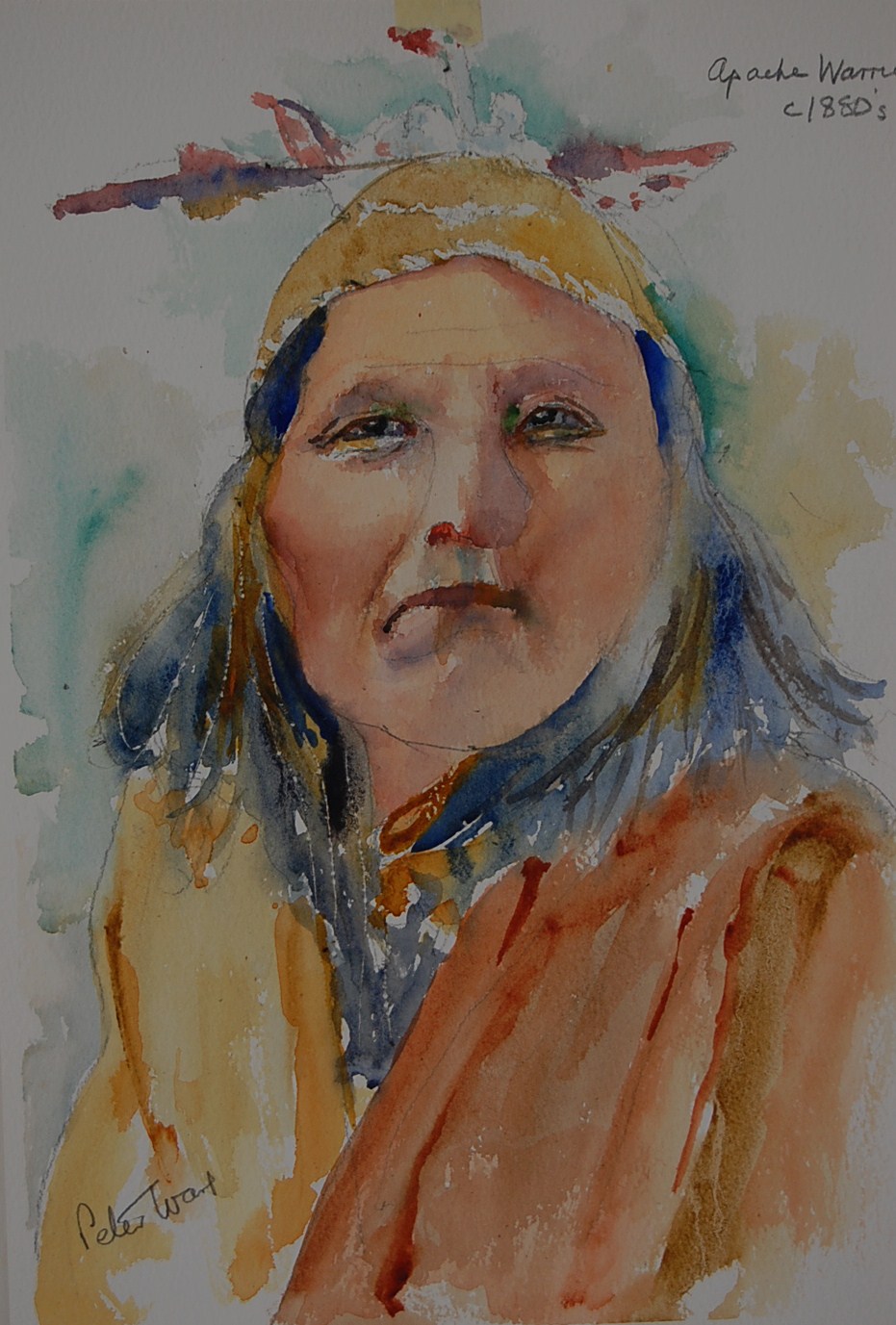
Apache Warrior 1880's 16" x 12" Waterford Rough

This is better than  the previous one shown on the blog but I am still not entirely satisfied - not that I ever reach 100% satisfaction far from it - and may try again.

I painted the features with my usual mix of Cadmium Red  Light and Cadmium Yellow Light but actually used a colour new to me, Windsor and Newton's Gold Ochre (PY42). This was used quite a lot instead of Cad Yellow and Raw Sienna. I rather like it. It is a rich golden yellow and was introduced in W and N's most recent changes to their colour range. Blues used were Cobalt, quite a lot of Ultramarine and a little Cerulean. I used the Ultramarine to get a darker face mix. Notice `Waterford Rough'. I normally use NOT papers but these Indian portraits do seem to suit it. On the Apache portrait I introduced Quinacridone Rust from Graham (PO48) in the clothing on the right hand side. It is rather brighter than Burnt Sienna - a lovely colour. Other colours used, other than in the features, include Ultramarine Violet (PV15 Rowney), Burnt Umber (Maimeri), Quinacridone Gold (PO49 Maimeri) and Permanent Alazarin (W and N). I forget to mention a touch of Hookers Green in the eye sockets and Black for the pupils.

As for brushes for the features I used two long handled Windsor and Newton Cirrus, Nos 2 and 4, Either Da Vinci or Rosemary Kolinsky No.6, and for the rest my Da Vinci Artissimo 44 No 2 Kolinsky Mop. This latter is a lovely brush roughly equivalent in size to a normal number 14. I also paint fairly upright.