Showing posts with label plein air painting. Show all posts

Tuesday, 18 October 2011

Charles Reid at Crantock - Day Three

It was decided to go to the National trust property Trelice, a few miles from West Pentire, on the Monday of Day Three and paint plein air. After it was discovered the house and grounds did not open until 10.30am, Charles decided to have an improvised question and answer session. What developed came about when Mick Carney asked a question regarding how to keep paints wet, as his experience was they tended to dry on him. Actually it was a fascinating discussion since it seemed to spark Charles off and gave him the chance to emphasize some of the things he holds dear and which he believes many students fail to grasp. During his initial thoughts he mentioned the Australian artists Robert Wade and David Taylor, both excellent watercolourists, although I don't recall the exact context.

The Charles Reid way, described in his many books and demonstrated in his videos, is to dip the brush into the water pot, roughly one third of the length, and then give it a good shake ( or two) before digging it into the  paint.  Don't take too much water out by wiping on a tissue for example. He suggested we think of the brush as a fountain pen water + paint. Don't stroke onto the paper and avoid the errors of too much paint not enough water and the reverse. This is one of the keys of getting things right. Place paint adjacently and don't smooth things out! Be cruder! Charles also demonstrated the way to see if the paint is the right consistency.

Hold the box near vertically and if the paint runs it has too much water.


We then had a demonstration of what this meant in practice and how to get the balance right between hard and soft edges, plus combining colours wet into wet. In my view the two best books explaining these tecniques are the most recent `Watercolour Solutions' and the 2001 `Painting Flowers in Watercolour'. ALL his tecniques are fully explained, contour drawing, brushwork and paint mixing. The flower book is accompanied by two very good videos.


The discussion became quite lively with him saying there were too many `strokers' amongst the students and many denied doing it. He is adamant you must not stroke with the point of the brush because, apart from anything else, it will quickly wear out. One student comment, very good humouredly, was that `we're all liars and strokers then'. This evoked a gust of laughter but he was getting his points across in a quite forceful way. I thought it was a very useful session and so did the others. We then departed for Trelice.

A closer look - combining colours

Charles and umbrella

When we arrived at Trelice the weather was still marginal. It was heavily overcast, some wind and very light drizzle. Only two or three had brought painting umbrellas, so the choice for others was paint and brave the elements or watch Charles. I elected to watch although this wasn't easy as you can see from the photograph. Those that painted in the morning suffered very light drizzle which accumulated on the paper and made painting a real problem, still several battled on. Charles, under his umbrella gave a  masterclass in painting a complicated building in adverse conditions. 


First steps. The stone lion, which you can just see in front of him was the starting point together with one of the party who had set up much nearer the house. He made the lion much larger than the actual statue which was considerably worn.. When painting outdoors Charles draws a section then paints, draws then paints, not completing the drawing before painting. The rational for this is that conditions are always changing when outdoors. They didn't change much here but he still  followed this procedure.


This sequence shows how the painting developed


 Two closer views

Note how there are no large washes. Quite a lot of splashing! See how colour has been introduced into what is a largely gray building even though there is much texture in the walls. Variation at every turn and simplification. Considering the conditions it was a brilliant effort and one my wife thought excellent, when she saw the finished painting back at the hotel. The way the subject was tackled gave me (and others) considerable food for thought. He used his small Craig Young Sketchers box and Escoda 1214 Kolinsky retractables. He has tried Escoda in the last two years and likes them. The normal equivalent is the1212 series.

After a break for lunch at the cafe in a converted barn people soon began to drift off back to the hotel, and by about 3.30pm that was it. There was no critique that night. It wasn't the best day of the course but had its moments.

Thursday, 28 July 2011

Plein Air

Last Saturday 23 July I painted in the garden at Pats house at Bitton.  This has been an annual event for several years, often twice during the Summer, but sadly this is the last occasion as Pat, who is quite elderly, is selling the house and moving to a much smaller property. We get coffee and biscuits on arrival and tea and cake after we have finished! I shall miss these occasions. 


Alan Coster painting last Saturday.

Alan has known Pat for many years and previously arranged similar outings at her former home which was a large converted farmhouse. It is actually arranged for members of Hanham Art Club, but I was once  a member and get invited because Alan and I also belong to the Avon Valley Artists. Alan is recovering from a serious knee operation and this was  only his second  time painting in nearly three months. 


On this occasion I decided to paint a small section around a window at the rear, having previously done mainly front views.

Window and Pots. Fabriano Artistico 18" x 12" Not

I used mainly two brushes Escoda series 1214 retractable Kolinsky-Tajmyr  sables sizes 12 and 8. Colours for the walls included Gold Ochre, Raw Sienna, Burnt Sienna and greys mixed from Cyan Blue and Cadmium Orange (both Maimeri). Although the walls look grey there are many subtle colours and representing them is a challenge. Gold Ochre for the window surrounds and various mixes to achieve a wide range of greens. Hookers Green (Maimeri) was used as a base, adulterated with other colours like Burnt Sienna and  Avignon Orange (Maimeri PR206). Faience Blue (Maimeri PB60) was used to darken the greens and Green Gold (Rowney PY129) to get a lighter yellow-green. Probably some Ultramarine in there somewhere and also touches of Ultramarine Violet (Rowney PV15). Take care with Gold Ochre (W & N PY42) as it is on the opaque side and used full strength is very powerful. A lovely rich colour nevertheless.

Monday, 25 July 2011

Pin Mill & Woodbridge

Last week my wife and I with two friends spent a few days in Suffolk. I had intended to paint at Pin Mill but the weather forecast, prior to going, was so bad with rain predicted every day that I only took a couple of sketchbooks with me.


The Tide Mill

 On the way to our B & B we stopped off at Woodbridge, a delightful small town just off the A12, a few miles North of Ipswich. This is another great painting location on the River Deben and has a famous Tide Mill. On this occasion the Tide Mill was under repair and swathed in what looked like pink plastic sheeting.  A short distance before you reach it is a building that is the home of the Woodbridge Art Club, who run regular exhibitions and indeed one was current. I spoke to one of the ladies there, explaining my interest, and she told me they had 200 members with a waiting list. This includes 25 potters and I was shown a small room with a kiln. The building is superb and on enquiring I was told it was owned by the council. It is actually quite big with one large room, a slightly smaller one and the potter's annex of two small rooms.  The standard of paintings was mixed, as is usually the case with amateur exhibitions, but there were some good works and a variety of media including watercolour. I wondered how on earth an art club, even one with 200 members could afford such a relatively palatial home. Apparently the group maintain the building, with no cost to the council, and pay a peppercorn rent as they are regarded, with continous exhibitions, as a tourist attraction. They have regular weekly painting sessions, workshops and longer courses with well-known artists tutoring. It is a hive of activity. To cap it all the annual fee is only £35! I took a number of photographs on the front here for possible future paintings.

 Woodbridge Art Club Exhibition

Another view

Taken just outside the Art Group building

Two days later we went to Pin Mill. Where is Pin Mill? It is on the River Orwell, near the village of Chelmondiston which is approximately six miles South-East of Ipswich. Pin Mill is a fabled location where many famous artists like Edward Seago painted, and in recent times John Yardley. Charles Reid made a video here for Town House Films in 2009. I believe on any decent day you will find artists at work  from the well-known professional to the humble amateur.

Pin Mill. The famous Butt & Oyster 17th Century pub in the right background


On the day we visited I indeed spotted some artists at work and wandered down to where they were.  I was careful not to interrupt but one particular man actually spoke first and said he was happy to talk. It turned out he was from a group known as `The Maritime Art Group' www.maritimeartgroup.co.uk and he was there with two others. I think he said it was his eighth visit. It appears they are a group of 17, holding regular exhibitions at various locations.


One of the Maritime members at work


Another view

And another

Unfortunately it isn't ideal to go on holiday, intending to paint, when you have friends who don't. My wife is fine as she will read a book for a couple of hours but it is different with others, even good friends. It just doesn't work well especially somewhere like this. As a result of this and the weather being very unsettled (to put it mildly) I only made a couple of rudimentary sketches but took lots of photographs and  hope to use some of this material in coming months. Plein air is great but if you want to paint regularly then photographs play a large part.

Monday, 9 August 2010

More Plein Air Paintings & Our Latest Project

A week last Thursday I painted at Newton St Loe. It should have been at Victoria Park in Bath but that is another story. Here is the result.

The Church at Newton St Loe.18" x 14" 152lb Veneto Not

I wasn't going to post this one but after looking at it a few times decided to take the plunge. Drawing wise everything is pretty much in the right place  and I simplified the scene. I was positioned just in front of the monument on the left and started the drawing at the front of the entrance in the centre. As usual I attempted to do this by modified contour drawing, drawing then stopping, leaving the pencil on the paper while comparing each section to get the proportions right. This doesn't always work for me - I'm not Charles Reid - but is not bad in this instance. Newton St Loe is a delightful village on the western outskirts of Bath. Apart from one residence all the others belong to the Duchy of Cornwall - in other words Prince Charles - and there is a waiting list to rent the various cottages, including some lovely thatched buildings. It isn't tiny and has a village shop with an annual fete on May day. My AVAS group usually put on an exhibition in the church during the fete. Prince Charles occasionally flies in by helicopter as the Duchy have a regional office.

Regarding the painting I used Raw Sienna, Raw Umber, Gold Ochre, Ultramarine Violet, some blues and other yellows plus Burnt Sienna. I am almost out of the true Quinacridone Gold and am trying Gold Ochre instead. Ah yes some Permanent Carmine in the roofs.

Thomas a Becket Church Pensford 18" x 14" 152lb Veneto Not


Last Thursday my Avon Valley Artists Group, seven of us, painted at a small village called Pensford several miles south of Bristol. All those present decided to paint this ancient building formerly a church but now, would you believe, being converted into a private residence. The church dates back to the 14th century but was badly damaged in the 1968 floods when the River Chew burst its banks and reached unheard of levels. It was then abandoned and has been rotting ever since but in 2008 was bought for repair (it is a listed building) to be turned into a home. Apparently the couple who bought it have four children.  When we were painting a lady invited us to look inside and see how the conversion was going and several did but I continued painting. I'm just amazed that anyone would want to live in it. The church itself is not enormous and is surrounded by a modest amount of ground but, as you will see from the painting, filled with gravestones, some of which appeared recently tended!  According to the lady it is to be the subject of a television programme. I cannot imagine how much all this will cost. The owner must be a banker or financier.

I'm not really into painting churches but decided to have a try and took the porch in the centre rear as the focal point. That porch is in need of repair looking at the state of the roof and the background was a sea of green from the surrounding trees. Other than that there were gravestones everywhere. Perhaps I should have left them out, or at least most of them. I painted almost exclusively with a number 14 round Escoda Kolinsky-Tajmyr Series 1214 retractable (Jacksons) to try and avoid being too tight. Colours used, lots of blues and yellows to get varied greens, Ultramarine and Burnt Umber or Burnt Sienna for the darks, Raw Sienna, Raw Umber and Gold Ochre (Windsor & Newton) for the buildings and I used Cyan Blue (Maimeri) mixed with Cadmium Orange (Maimeri) for various shades of grey. Possibly a few other touches such as Green-Gold (PY129) Rowney.

Our next project

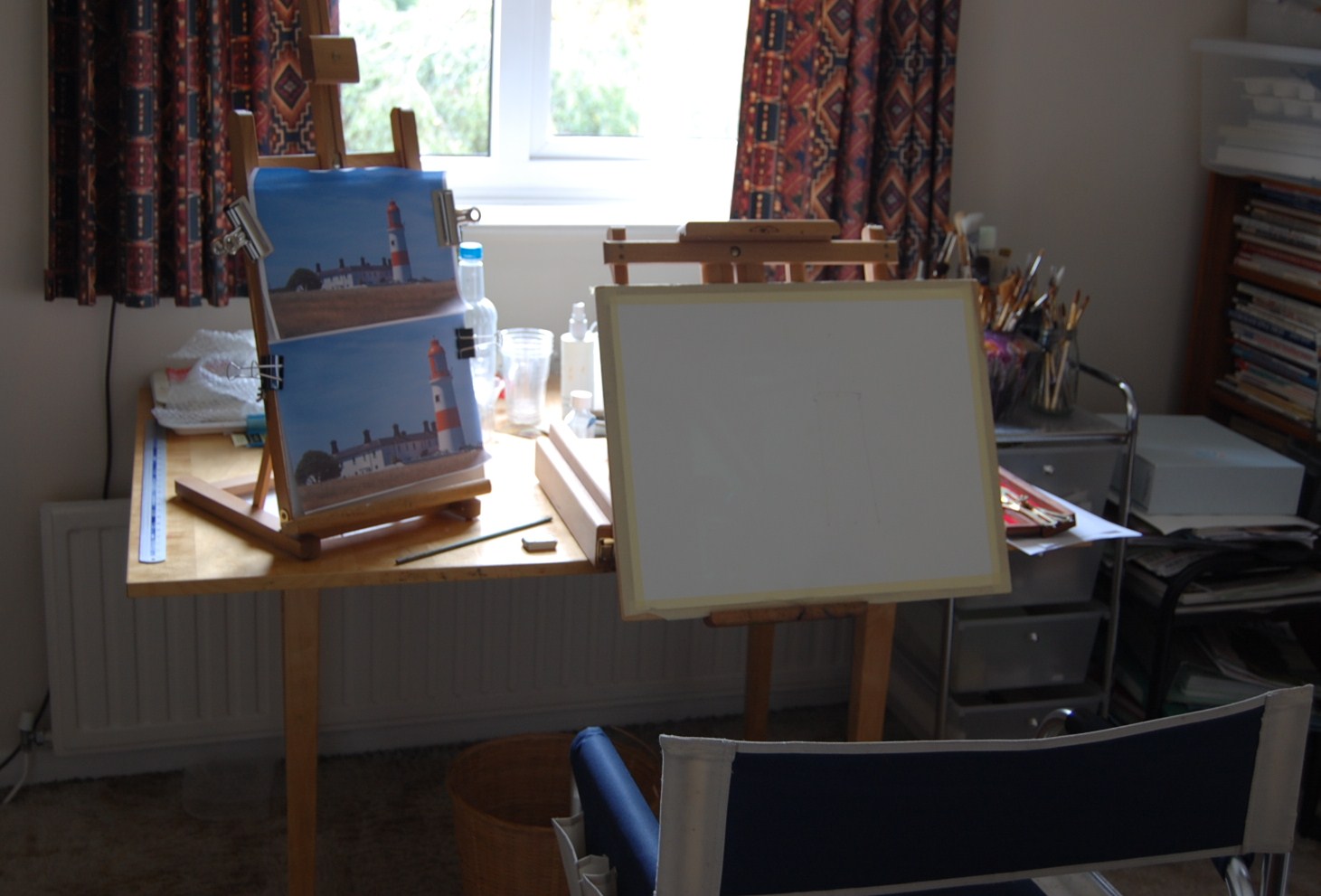
This is me working on our next project. The subject and photos were supplied by Mick. This is my `studio' a converted bedroom. My wife keeps wanting to sort it out as I have stuff everywhere. You can see why I wear a cap most of the time when outside.


This is where I draw and paint when not outdoors. The drawing is partially completed.


Monday, 12 July 2010

Latest Plein Air

This is my latest effort, painted last thursday at Dundas Acqueduct, a few miles outside Bath on the A36 Warminster road.

Saunders Waterford 16" x 12" Not - Dundas Boats and Barges

Dundas acqueduct is a popular location, part of the Kennet and Avon Canal, a favourite of barge owners and canal holidays. The area where we paint is a spur of the canal which runs to a basin close to the main road. It has a shop where you can hire boats and bicycles, an excellent cafe/restaurant, and is usually quite busy or indeed very busy.

On this particular day the waterway  was packed with end to end barges plus a few other types,  used either as houseboats or parked up. On certain weekends you can take canal trips and some are also available for wedding parties and celebrations of all sorts. A very lively place although it was quiet when I started and only the odd person stopped and tried to engage me in conversation, something that Judi Whitton (and others) say you have to `nip in the bud'. It is difficult as one doesn't want to seem rude, but concentration can be affected if onlookers are too persistent.

I started painting at around 10am and finished at noon. This was my usual attempt at painting with a first time finish, using paint straight from the paintbox (a mix of full and half pans) without overmuch mixing or messing about. Obviously some overpainting takes place but I try to keep it to a minimum. My (attempted) methods are based on those used by Charles Reid and Judi Whitton. I used several different blues and yellows for the greens. The large tree in the background had leaves that are very grey/green and I used Primary Blue - Cyan (PB15-3 green shade- Maimeri) mixed with Cadmium Orange (PO20 Maimeri) to create this greyish effect. If you play around with these two colours you can create some wonderful greys but take care which Cad Orange you use. The Windsor and Newton version is a mixture of Cadmium red and yellow, while Rowney do use PO20, the correct pigment, but add a yellow to it. Unless you use pure Cadmium Orange you will get a different colour.

I looked at the painting the following day in my `studio' and made some small colour additions. Otherwise I am quite pleased with it. I have done several others at this location, not all from the same viewpoint.  

Tuesday, 20 April 2010

Plein Air

For the first time this year I was able to paint outside this last weekend. The location is about 100 yards from my home, which although in a modern estate is on the edge of farmland. I have painted this scene many times with varying results.


The first attempt was last Saturday and after unloading all my kit I realised I had forgotten the walkstool! This obliged me to paint standing up which I'm not comfortable with. I know many top artists like Trevor Chamberlain say you should stand up to paint but each to his own. I don't have the steadiest of hands and sitting down enables me to overcome this handicap by resting my little finger on the paper a la Charles Reid. The first painting was unsatisfactory once I had a good look at it and it was soon discarded. This prompted me to try again, and with excellent weather conditions I returned  on Sunday to the same spot. The resulting painting, which I was more careful with follows.

Fabriano Artistico Not 19" x 15" Keynsham Manor

Keynsham Manor has a long history going back some hundreds of years. There are a pair of really enormous beech trees at the entrance, which I relegated to a minor role and simplified. They tower way above. Owls usually nest in one of them. Overall it is a very complicated subject with masses of `stuff'  and in the past I've often tried to put too much in. The Manor is now split into three separate residences and I know the couple who own it and live in one section. John has told me something of the history.