Showing posts with label drawing. Show all posts

Sunday, 1 February 2015

Bath Portrait Drawing/Painting - 2nd Week


 This was the second week of the course and was more demanding. Jackie spoke to us first regarding what she wanted us to do, the overall purpose being to  adopt a more relaxed, more impressionistic and less formulaic approach, something many artists slip into - their comfort zone. The session was broken into four distinct parts using different drawing mediums, fine liners, graphite sticks, charcoal and drawing ink. We were told we shouldn't take more than ten minutes or so for each study but invariably they took longer.


Fine liner sketch on A2


This drawing was with a graphite stick and one of the things we were required to do was move to another easel - two places - after each session so the angle of the model was different. From this you can see I got the front profile of the features wrong and had to the redo them but was unable to erase the earlier marks.


Ocado Drawing ink applied with a sharp stick, one end chisel edged the other pointed. I rather enjoyed this even though it created a `black' result.


UGHH!!!

Sight unseen drawings. I was reluctant to put the above two drawings on here but warts and all! This was actually the third task and we had to place our body and head slightly in front of the paper and easel. We weren't allowed to look at the paper and were asked to draw a continuous line!  In effect your head was slightly ahead of the easel with your drawing arm hooked round onto the paper, while all the time looking at the model.. Jackie showed us several examples of where she had made drawings using this method and they were universally excellent even if each somewhat different. I found this very difficult as the above examples show. I wouldn't say most of the other (9 this week) were a lot better, although some were. Where comments were made about mine Picasso was mentioned but I fail to see that connection - rather just a mess.

As mentioned earlier we were supposed to take not much more than ten minutes on each but they still filled a two and a half hour session, even with a thirty minute break!  I think it fair to say that everyone on the course is enjoying it. I did this course two or so years ago and it has moved on to some degree.

Wednesday, 3 July 2013

Drawing

It is often said that sound drawing is the basis of all good painting. I don't think many will dispute this and certainly my advice to anyone starting young would be to spend the first two years just learning to draw properly. Workshop teachers will tell you that one of the problems they have is that students - particularly those who have taken up painting late in life - want to start  painting immediately without getting too involved in the basics. I have made sporadic attempts to improve my drawing and it is certainly better. One of my problems is that I don't have the steadiest of hands, a reason why I was attracted to the Charles Reid method of modified contour drawing. I don't pretend I can do it as well as him, but even Charles has been heard to say some people think he can't draw a straight line. During my association with various local art groups, and on some workshops, one comes across quite a few people who have had occupations that involved precise drawing. Many want to `loosen up' but find it very difficult to use this kind of drawing skill to produce good paintings. This is a general comment  and there are always exceptions to the rule. 

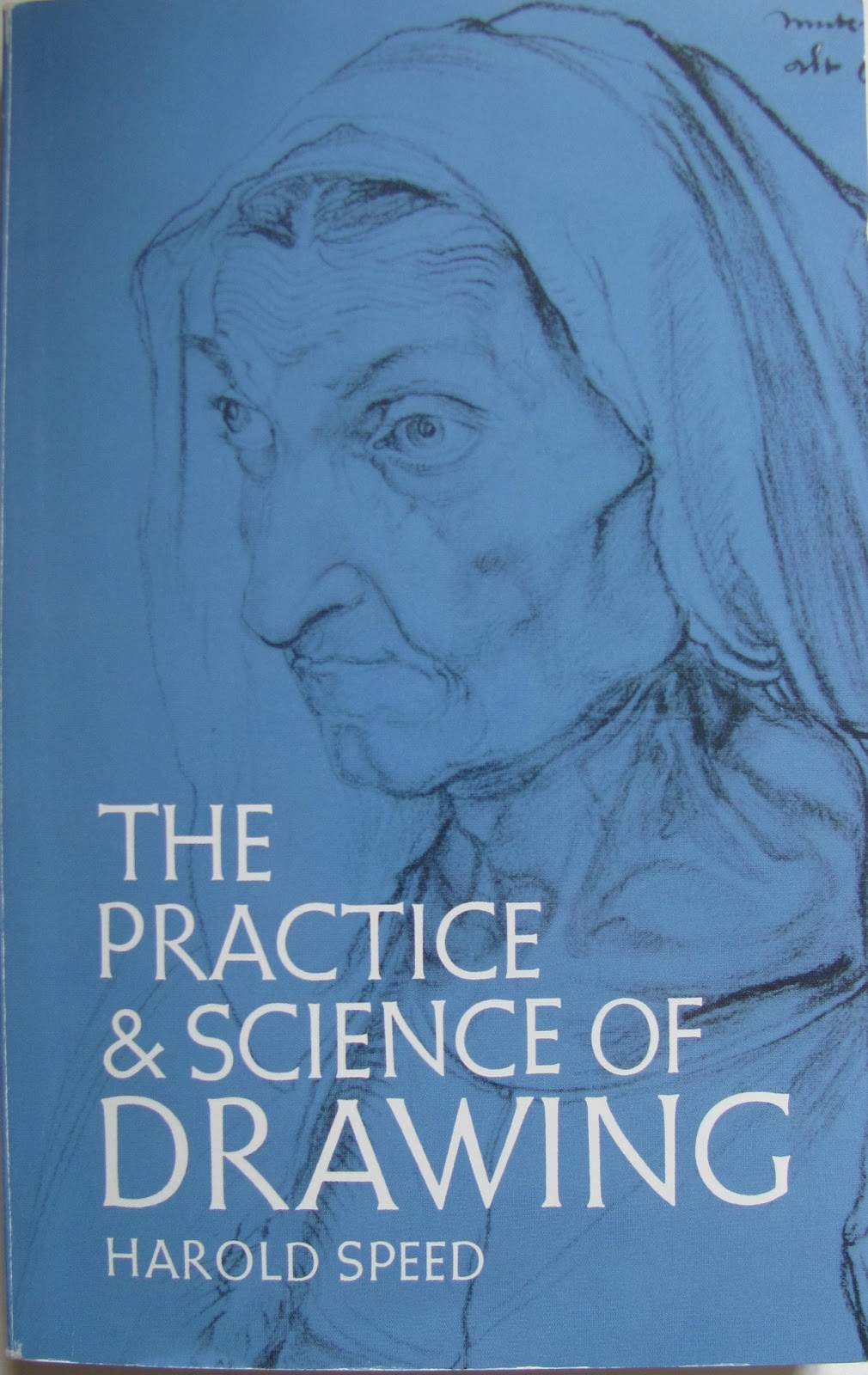
There are hundreds of books on drawing, all claiming to be the best in various ways, and it is difficult to choose from such a variety. Some cover drawing from the basics to the pinnacle, while others cover specific subjects. I have accumulated quite a number but don't pretend I have studied them cover to cover.


This is the classic work by John Ruskin, first published in 1857 and remains: "one of the most sensible and useful, both for the amateur and the professional artist.


Originally published a century or more ago this is another classic full of sound advice. It isn't just a how to book but covers every angle ..."brings to the beginner a clear statement of the principles that he will have to develop and their importance in creating a work of art"...


If you wish to go the Atelier route then this book by Juliette Aristides is a good starting point together with her previous works `Classical Drawing Atelier' and `Classical Painting Atelier'. This type of drawing is enjoying a revival with a number of `Atelier' schools having been set up fairly recently. Probably best for the young, dedicated art student just starting up. It comes with a DVD and I shamefully confess I haven't viewed it - yet.

I'm not going to mention all the books I have just a few I particularly like.


This is my favourite recommended by Charles Reid, who considers it the best book on drawing. I like it a lot and  believe it would help most of us who wish to improve our drawing skills. Dodson wrote a second book but I didn't like it nearly so much.


This is written by the Bristol artist John Palmer in the Ron Ranson `Painting School' series. John has an idiosyncratic style that might put off many but is highly individualistic and exciting. Not for everyone. His pencil work is astonishing.


This is just one in a whole series written by Barrington Barber, a British artist and teacher. They are basic, inexpensive primers full of sound advice.

I have several others including the Betty Edwards `Drawing on the Right Side of the Brain', a seminal book which has sold in huge quantities and several editions. I've never really got into this one I have to confess. As an amateur `dabbler' I don't pretend to have an encyclopaedic knowledge of  drawing books and no doubt there are many other choices of equally valuable books. I once started a thread on Wetcanvas, actually as research for this post, asking for members views on the very best books but all I got  was the usual litany of advice about which or what one I ought to get, most missing the point completely. 

All the above were obtained from either Amazon or Abebooks. The only one that proved difficult to obtain, eventually from Abebooks, was John Palmer, which was also the most expensive. Prices on all the others were very reasonable.


Wednesday, 29 February 2012

Bath Portrait Course Week 7 of 10 - 27 February 2011

This week was an eye opener. Jackie asked us to use ordinary brown paper, the sort parcels are wrapped in, so I bought a large sheet from the college shop for the princely sum of 20p. The model was again John. 

 John

Actually we were asked (told!) to do a full size drawing including legs and torso. Then the catch. We were asked (told!) to use a green stick about 20" long - slightly larger in diameter than a pencil - of the type sold at garden centres as small plant stakes. Attached to one end by masking tape was a piece of willow charcoal.  Apparently this is something the old masters did, use very long paint brushes for very large paintings and we were shown some photographs illustrating this tecnique. Some appeared to be wall paintings. You have to hold the stick at the very end, not being allowed to cheat, and having your arm outstretched. 


John - Brown Parcel Paper 29" x 44"

As you can see this is huge and it was a daunting experience, wondering where to start and how to proceed. I did not enjoy the first session much but by the second one was coming to terms with it and  was fairly satisfied - with reservations - about the result. I've made him rather fatter than he actually is and  as you can see couldn't get his legs in because I didn't initially set the midpoint correctly. Better to run off the sheet than try and cram him in which I noticed a couple of others did with the usual results. Apart from slight use of red and white crayons on his head I stuck with this long pole throughout. 

What is this to do with a watercolour blog? Drawing is the basis of all painting and I certainly wish I had given more attention to it when I first started. The apparent reason for the procedure just described is to encourage `looseness'. Next week we have Sarah back with the hat and I'm hoping to paint a `Charles Reid' type of watercolour of her.

I shall be returning to other subjects in the next few weeks, several are in draft form, so don't think I'm becoming too portrait oriented.

Wednesday, 22 February 2012

Bath Portrait Painting Course Week 6 of 10 - Tuesday 21 February

After a weeks break for half term we resumed yesterday. The subject was again Sarah, this time wearing a hat and different clothes. She was  in a slightly different position in that she was sitting on a chair rather than the raised platform - so actually a little lower - on the opposite side of the studio. Unfortunately I forgot my camera so was unable to take photographs but in two weeks time we will have a more or less identical pose.

Jackie our tutor suggested we concentrated on drawing  and do so fairly large. Those present (6) used either pastels, charcoal or in my case thick graphite leads. I opted to use a Koh-I-Noor Hardtmuth 5340 metal lead holder with 5.6mm Cretacolour lead. Ordinary graphite pencils of 0.5 to 0.9 are much too small for such a large drawing on A1 paper. Looking at both Great Art www.greatart.co.uk/ and Jacksons www.jacksonsart.co.uk/  I couldn't find any Koh-I-Noor holders on Great Art but they do offer a Cretacolour one at £5.75p. Jacksons have the Koor-I-Noor Versaille 5347, which also takes the same size leads BUT it isn't in the catalogue. Cost is £5.10p and additional leads (6) are £2.70p. This type of drawing tool is more suitable for  larger drawings and enables (in my opinion) one to draw freely yet still make a realistic image. Incidentally  more and more products are on the website but not in the catalogues.


Sarah 33" x 23" A1 220 gsm Cartridge Paper

The resemblance is quite good and overall I am pleased.  You may think the folds in her clothing are too dark, but my thinking was that having emphasized her dark hair and eyes I had to do this to link everything together and better to have greater contrast than be insipid. This course is certainly taking me into new areas which I hope will enable me to raise my game generally. It is exhilarating. Comments welcome.

Next week we have John back followed by Sarah. In the final two weeks we will have a new model so plenty of variation. I am thoroughly enjoying this course and seriously considering taking the follow up 5 week Summer term.


Sunday, 18 December 2011

John Palmer

In my highlighting of  artists I now want to introduce a local one, whom I've met several times and seen demonstrate. I first heard of John Palmer via Judi Whitton who was using Papermate disposable pencils.  She explained that she'd originally seen John using them. John has this amazing and unique drawing tecnique. He doesn't have a website nor has he made a video. He did tutor courses at one time for EPC in Catalonia but doesn't feature in their current schedule. John is a member of the prestigious Bristol Savages and a full biography is  on the website. www.bristol-savages.org/current-artists/96-palmer-john-frederick-rwa-.html   Some of his paintings are also shown. Essentially his paintings are primarily drawings with a wash or two added, usually fairly nondescript. The drawing is the thing. His paintings have appeared in several books by other artists including  Judi's `Loosen up your Watercolours' (Collins 2005).

 A friend of mine knows him well and suggested John should really be better known. He usually exhibits at the RWA (Royal West of England Academy) at their annual exhibition at Clifton, Bristol and also features in at least one gallery in Bath.


Fortunately there are two books, in the `Ron Ranson Painting School series' (Anaya Press 1993/4), that showcase John's talent. In my view by far the better book is `Drawing and Sketching' which is attributed only to John, whereas the `Watercolour Landscape' book is shown as joint authorship with Ron Ranson. The drawing book showcases his skills in amazing detail and I haven't come across another comparable artist. John is different! The Watercolour book, while interesting, isn't in the same class. When I originally tried to obtain these books, several years ago, they were hard to find but I eventually managed to buy the drawing book. Recently I felt I needed to revitalise my landscape painting and also look at other artists, even if very different to my `guru' Charles Reid. This is something he recommends. No tunnel vision here! I wouldn't try to emulate his style even if I could but there are things to be learned, as from many other artists, and who knows maybe a slight touch of the magic will rub off!

Both the copies I have of the above books are in excellent condition. I obtained the Watercolour book only recently with a slight hiccup, as the first bookseller could not find it, despite advertising on the Abebooks website. Fortunately a second did have a copy although at a slightly higher price. Prices vary enormously between booksellers and I've just checked Abebooks www.abebooks.co.uk , a brilliant website, and the Drawing book is available at 0.64p plus carriage from one or two UK booksellers rising to over £20 from American sources, while the inferior ( in my opinion) Watercolour book starts at £24 - £25 from the UK to over £65 including carriage from Canada. Note added 19/12: I've had another close look at the watercolour book and perhaps I should have been more positive about it. I stand by my view that his drawing book is superior but the second book has much to commend it. 

To sum up I can understand some will look at John Palmer and think him quite tight and realistic - verging on super realistic at times. Actually this is a simplistic view as he is very versatile with often a loose impressionistic approach. 


Friday, 11 June 2010

Latest Acquisitions


The Variscaler


I don't have many books on pure drawing, the most important ones being `Keys to Drawing' by Bert Dodson, which was recommended by Charles Reid, `Drawing on the Right Side of the Brain'  by Betty Edwards and `Drawing and Sketching' by John Palmer. None of these are what you might term orthodox drawing books of which there are many. I have one or two others.

Recently on a visit to pick up a book at my local library I noticed the figure drawing book above on the `new acquisitions' shelf. On impulse I loaned it and after perusing  thought it worth acquiring permanently. On searching Amazon http://www.amazon.co.uk/ I discovered the author, one Barrington Barber, to have a whole range of books basically all on various facets of drawing. Amazingly Amazon list 67 although this includes some duplications, different editions of the same book, and also several translatuions in at least three other languages. I confess I'd never heard of him but he is obviously highly regarded in his field and currently combines teaching art with ` a successful career as a commercial illustrator and artist'. He is British and enquiries on Google bring up more information. These books are not expensive most retailing at around £9.99 and available on Amazon at a good discount. I ordered the figure and portrait books but Amazon, after initially accepting the order, e-mailed to say the portrait book was unavailable. On to the second hand internet mecca Abebooks http://www.abebooks.co.uk/ . Sure enough they had several copies and I noticed the second supplier listed was Bookbarn in Somerset. As we intended to go to a farmshop the following week, and would pass Bookbarn on the way, I decided not to pay the postal charges but call in. To cut a long story short I bought the book for £2, in mint condition, not before querying why they wanted to charge me £4.40 when the internet price was £2.30! This confirms one of the rules from my days of selling which is `if you don't ask you don't get!  I am very much into the Charles Reid contour drawing system but I like the look of the above books and am sure they will be helpful.

On to my second recent acquisition which is a proportional divider. My drawing skills still need much polishing and while I usually get there in the end it can be a tortuous process. Anything that helps to speed up things and ensure a more accurate result is worth a try.  I initially bought a cheap one from the SAA, to which my local AVA group is affiliated. This was rather rough and ready and also quite large so after trying it a few times, and  deciding the principle was useful, I sought a better instrument. If you Google `proportional divider' the results are fascinating. The history of such things comes up and on offer are a whole range including very expensive antique versions. I finally settled on something called the Variscaler from Black Mouse www.blackmouse.co.uk/variscaler.htm . It cost £25 plus carriage and is a well-made instrument in brass in a nice wooden case. Full instructions came with it and while I have not yet fully come to grips with using it I hope to do so soon. My intention is not to produce highly detailed drawings but mark key points in the drawing to use as guides, aiming for a loose but accurate result.