Showing posts with label Edward Curtis. Show all posts

Thursday, 15 August 2013

Avon Valley Artists and Beaver Tail.

I imagine many will wonder what this title means. In a nutshell it was the latest AVA session and I painted an Amerindian called Beaver Tail.


Fourteen present today, which is almost as many as we get with the official programme. We have two more weeks of `do it yourself' painting then the official programme starts.


Just to prove I was there!


Yvonne Harry


Jan Weeks unfinished.

Yvonne and Jan have just returned from their highly successful ten day exhibition  at Wells Cathedral, where combined sales of framed and unframed paintings exceeded 60.


Some of today's paintings.
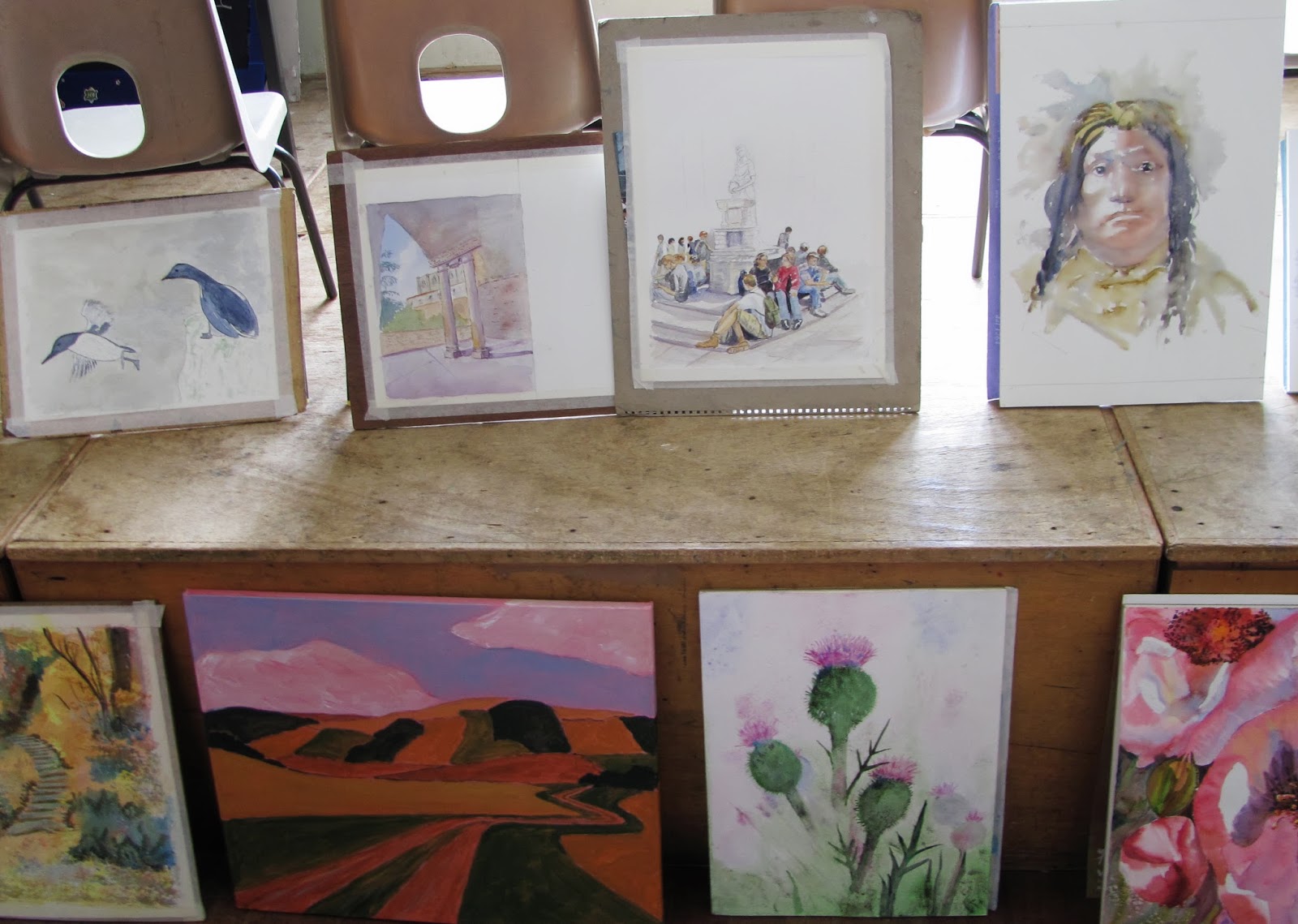

And some more.

The last portrait I painted was at Stow with Charles Reid. That was in May. Problems and distractions since then reduced my painting time considerably but I did attempt one last week - unfortunately a disaster on hot press paper. My normal policy is, rather than brood about failures, to go straight back in and it usually works - at least I think so. This week I attempted to paint an Amerindian called Beaver Tail, an Assiniboine Indian as photographed by Edward Curtis in 1908.


Beaver Tail 16" x 12" Fabriano Artistico Extra White 300gsm Not

I began with a careful but not over detailed drawing, taking measurements to ensure things were in the right place. For this I used a mechanical 07 pencil with 2B lead. You can see the sequence of events so I won't elaborate. The actual painting is a little darker than it appears on here, especially the shadow areas where I added a second wash. I'm sure Hap will say I haven't got the skin colour right but on this occasion I just wanted to get the show on the road again.   I'll do better next time Hap.

Colours used were limited. Cadmium Red Light, Raw Umber and Cobalt Blue for the skin colours. The hair Ultramarine Blue, Burnt Sienna and Raw Umber. His clothing Raw Umber. The cap is Raw Umber and Raw Sienna. I used three brushes. Escoda 1212 retractables sizes 10 and 12 plus the Isabey retractable size 6.


Tuesday, 13 November 2012

Left Hand

The Comanches - Lords of the South Plains - were one of the most feared of all Indian tribes. In the late 18th Century it was estimated there were around 45,000, one of the most numerous tribes, but numbers declined so that by 1870 only 8000 were left. The low point came in 1920 with census figures of only 1500. Present day numbers are around 15000.

Comanches were renowned as magnificent horsemen, more at home on a horse than on foot, and  had a reputation - in addition to that of ferocity and cruelty - as excellent horse breeders. Before the coming of the whites they waged war against the Spanish and later the Mexicans and took many captives, some treated as slaves others eventually adopted into the tribe.

At the high point they roamed an enormous area  which covered present New Mexico, Southern Colorado, North-Eastern Arizona, Southern Kansas, Oklahoma and most of North-West Texas. Their home territory was known as Comancheria and they resisted white encroachment - often described as the Comanche barrier to settlement - for many years. The Comanches and Texans especially hated each other and  dreadful hostilities continued between them until the final surrender of Quanah Parker in 1877. For a good history try Wikpedia. I have several books of which `Comanches' The Destruction of a People by T.R.Fehrenbach is excellent,and `The Comanches' Lords of the South Plains by Ernest Wallace and E.Adamson Hoebel another. Quanah Parker, son of a Comanche chief and a white captive woman is one of the most famous individuals, see `Empire of the Summer Moon' by S.C.Gwynne. He later became a wealthy cattleman and  celebrity.


Left Hand - Comanche Warrior circa 1900
www.firstpeople.us/

Edward Curtis the famous photographer and author of the monumental `The North American Indian', took most of his photographs beginning around 1895. By this time the Indian wars were over but memories were still raw. Much resentment remains to this day, especially on the present day reservations. This photograph may have been taken around 1900 or a little later. I know nothing of this individual other than he was a tribal elder.


Left Hand -Waterford 16" x 12" 140lb (300gsm) Not

I first made a careful pencil drawing using a mechanical pencil  07 with a 3B lead. Beginning with the eyes I painted the features first. Skin colours were various mixes of Cadmium Red Pale (Rowney), Quinacridone Rust (Graham PO48), Raw Sienna, Cobalt Blue and a little Burnt Umber all (mainly) mixed on the paper.. The fur hat is mixtures of Quinacridone Gold (Daniel Smith PO49), Raw Umber and Raw Sienna. The shirt is Cerulean Blue and Gold Ochre (W & N PY43). I wonder of Hap will approve of the skin colour?

Saturday, 13 October 2012

Edward S. Curtis

Edward Curtis is an iconic figure in American history, although somewhat controversial. He was a famous photographer and also wrote the `The North American Indian', an enormous work in 20 limited edition volumes, published between 1907 and 1930. There are over 1500 illustrations of black and white photographs, taken by Curtis over a period of many years commencing about 1895. The Firstpeople site www.firstpeople.us/ has many if not all and they are free to download and use, but not for profit. If you Google his name a vast amount of links appear.


16" x 12" Centenaire 140lb (300gm) not.

 I started off with a pencil drawing using a 2B pencil. I kept this fairly simple and made no attempt to put in `missing detail'. By this I mean that which isn't visible in the photograph. For the features I used various mixes of Ultramarine Violet (Rowney PV15), Quinacridone Rust (Graham PO48), Cadmium Red Pale and Cobalt and Ultramarine Blue, with a touch of Raw Sienna. The underside of the hat is mainly the same colours in heavier mixes. His beard is combinations of Raw Umber, Raw Sienna plus diluted mixes of Ultramarine Blue and Burnt Sienna. I allowed the painting to dry thoroughly then made some small changes and additions the following day. The head is silhouetted with the same dark colours. I tried to paint him following Charles Reid's  advice `cruder' rather than fussy and in a more adventurous manner. 

His hat colours are combinations of Ultramarine Violet, Raw Umber and Raw Sienna.The coat is a mixture of Quinacridone Rust and Raw Umber. 

Brushes used were the Da Vinci Artissimo 44 Size 2 Kolinsky and the Isabey 6228 Size 4. 


Wednesday, 22 August 2012

White Calf - Piegan

White Calf is another in the long list of Native Americans photographed by Edward Curtis, a somewhat controversial figure so I am told by an American friend, in the second half of the 19th Century and the early part of the 20th. Interestingly there was a TV programme about him recently, which I have recorded but not yet viewed. Apparently his huge photographic archive was in danger of destruction but was rescued. This happened sometime in the 1930's.

White Calf - www.firstpeople.us/

I am intrigued by these old photographs and it is a challenge to convert them from  more or less quite stark sepia images to colour. This is my latest of what is becoming quite a long line, although most of the early ones have been discarded. The Piegans or bloods, better known as the `Blackfeet', were a numerous and warlike tribe that straddled large areas of Canada and the adjacent United States. I don't know anything else about this individual, although I guess the photo was taken around 1900 and he appears quite old.

White Calf - Saunders Waterford (I think) 15" x 11" not.

Corrected Version - added 23/08/12

Added 23/08/12: In view of the critical comments I received over the original painting I have made some corrections that address the main criticism that the jawline gave him a simian appearance. It isn't perfect but does improve the overall effect, although I am conscious, as always, it could be better. I don't object to criticism, although I try not to attract too much! One thing I think the artist must be conscious of and that is not to get into thinking you are better than you actually are.  In the same way that adverse criticism shouldn't depress you too much, equally don't be misled in the opposite direction.


I first made a careful but not over detailed pencil drawing. This was done earlier in the week. I first masked off many of the light areas shown in the photograph using an old brush with Pebeo Drawing Gum. After it was thoroughly dry I commenced painting. I am currently reasessing how I paint and making some changes. Here I wet the background with clear water, some of which leaked into the head. I put some diluted Sap Green (DS PO49/PG7)) and Quinacridone Coral (DS PR209) into the wet areas and let it mix and run down, with, as usual, my board at a fairly steep angle. I painted in the dark areas of the face and left hand facing side, and under the chin with various mixtures of Cadmium Red Pale, Raw Sienna, Cobalt Blue and Quinacridone Rust (Graham PO48). To get the darker colours I increased the amount of blue. I tried to avoid lines of `demarcation' since many would be painted over later. The hair was mainly various mixes of Ultramarine and Burnt Sienna. Some magenta also got mixed in. When thoroughly dry I removed the masking fluid and carefully painted over the features, accentuating the shadow shapes. After returning home I later used Galeria Acrylic Titanium White on small highlight areas using a No.2 pointed brush then, rather more vigorously a small bristle brush on the hair. I assumed from the photograph that being quite old he certainly had greying hair.

Brushes used for the main painting were the Escoda Tajmir retractables sizes 10 and 12  plus a Rosemary retractable size 6. The Isabey retractables sizes 4 and 6 were used for the eyes.